Recognition
Begin with a detailed checklist of coercive-control behaviors and prompts that help you map the pattern across your relationship.
The Invisible Cage
When rules, fear, monitoring, isolation, or pressure have taken up more and more room, it can be hard to see the pattern while you are living inside it. This private guide gives you a place to name what changed, what it cost you, and what you want to bring back into your own life.
A private guide for recognition, impact, and reclaiming yourself.
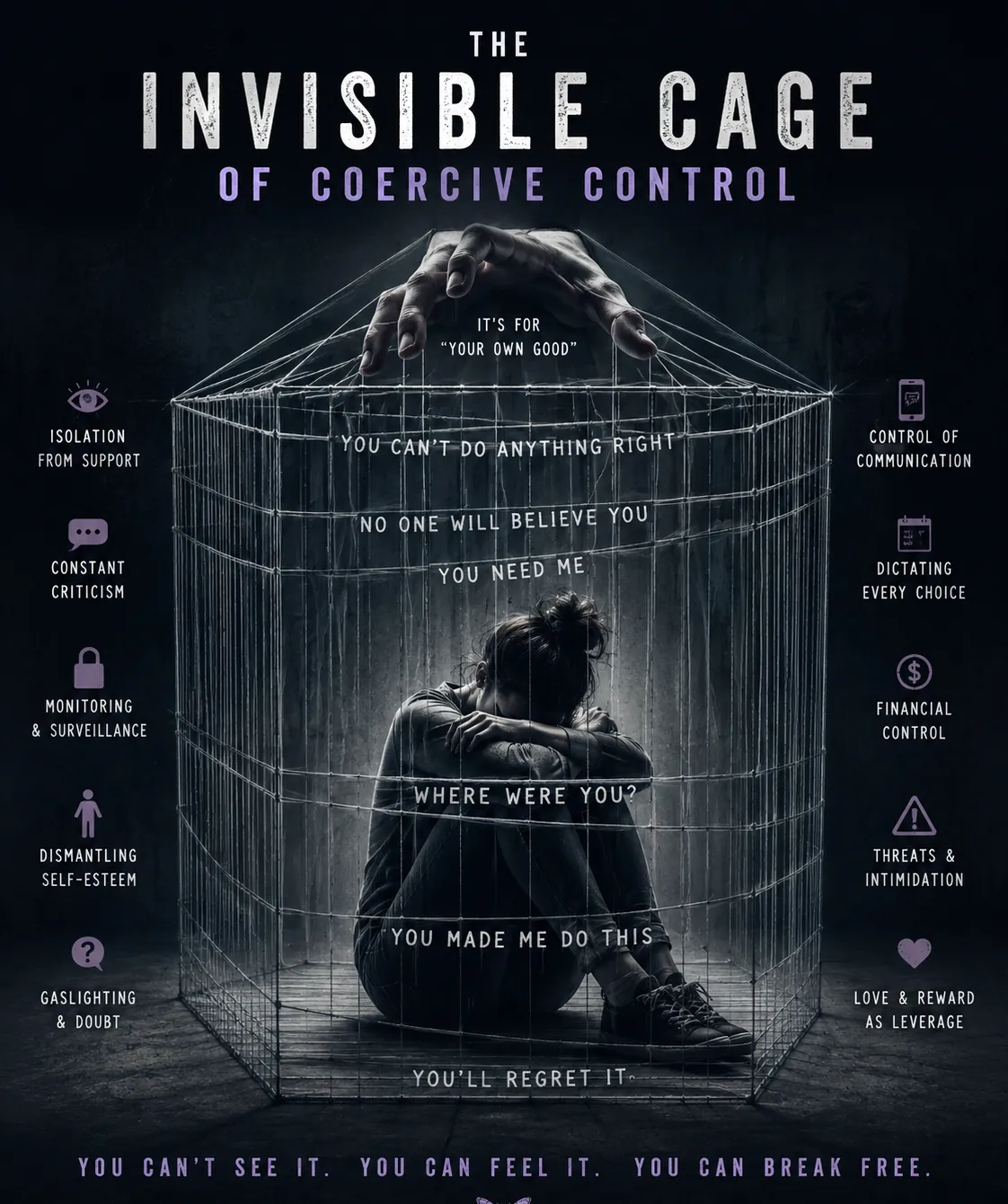
When the rules keep moving
Coercive control does not always arrive as one dramatic event. It can build through small demands that become easier to follow than to question. You may start explaining where you are, changing plans to avoid an argument, losing access to money or privacy, or slowly seeing less of the people who made you feel like yourself.
From the outside, each moment can look easy to explain away. Maybe they were worried. Maybe they were having a hard day. Maybe you could have said it differently. But the larger question is what happened to your freedom. Did your choices become harder? Did you start feeling watched, punished, isolated, or afraid to say no?
The Invisible Cage is not here to tell you what your relationship is or what you must do. It gives you a structured place to look at the pattern in your own words. You can begin with one question, stop when you need to, and return only when it feels useful. You are allowed to take your discomfort seriously before you know what every next step will be. Your story does not need to be dramatic, complete, or approved by anyone else before it deserves care.
Inside the guide
The guide follows the experience in the order many people need it: first seeing the pattern, then naming its cost, then considering what you want to reclaim.
Begin with a detailed checklist of coercive-control behaviors and prompts that help you map the pattern across your relationship.
Look beyond what happened to what it cost you: your routines, friendships, choices, confidence, and sense of who you were before.
Use four structured prompts to consider the interests, boundaries, decisions, and relationships you want to begin making room for again.
A place to start noticing
Start with the pattern
Control often works because it does not look the same every day. There may be warmth, apologies, promises, or periods when things seem calm. Then the monitoring, criticism, pressure, or isolation returns. It can leave you comparing each hard moment to a good one, instead of looking at what has repeated over time.
The recognition section gives you room to notice those repetitions. You can look at the ways control may have shown up around communication, time, money, privacy, relationships, work, clothing, decisions, or your right to have a different point of view. You do not need to check every box for your experience to matter.
A useful question is simply: what did I have to keep stable for this relationship to feel safe? Sometimes the answer is an entire day built around someone else's mood. Sometimes it is a constant calculation before you call a friend, spend money, disagree, make plans, or come home. Naming that calculation can be an important first step toward hearing yourself again.
A guide, not a demand
The Invisible Cage is a $6 guided digital resource. It is made for private reflection, not for proving anything to anyone or forcing a decision before you feel ready.
Use the guide when you need language for the rules, pressure, fear, and shrinking choices that can make a relationship difficult to explain.
Get The Invisible CageWhen it feels safe to write more regularly, My Clarity Journal offers room for facts, feelings, repeated patterns, and what you know now.
Explore My Clarity JournalWhat it can help you hold
It is easy to focus only on what someone did. They checked your phone. They made you cancel plans. They questioned every purchase. They turned your friends into a problem. Those details matter. The impact matters too: the routines you stopped having, the confidence that became harder to access, the choices that no longer felt like yours.
The impact section asks you to look at that loss with care. Who were you before the relationship started to narrow? What did you stop enjoying? What did you begin hiding? Where did you direct anger inward because it did not feel safe to put it where it belonged? There is no right answer. The purpose is to make room for the parts of your experience that may have been dismissed for too long.
Reclaiming does not have to mean a big transformation. It can begin with one small return: a friendship, a preference, an afternoon without explaining yourself, a boundary, an interest, a decision you make because it is yours. The guide closes with four prompts for considering what you want to bring back, at a pace that belongs to you.
Reclaiming can be quiet
After a long period of adapting to someone else, even a small preference can feel unfamiliar. That does not mean you are doing it wrong.
Notice one ordinary decision you can make without asking yourself first how someone else will react. It might be what you wear, who you call, where you go, what you spend an hour doing, or simply what you think.
Control can make your interests and relationships feel less important than keeping the peace. The guide gives you room to remember the friend, routine, hope, creative work, boundary, or part of your personality that became harder to reach.
For one person, reclaiming may mean reading quietly and admitting the pattern. For another, it may mean talking with a trusted person or finding confidential support. There is no prize for rushing and no shame in needing time.
If a person is monitoring your device, limiting access to money, threatening you, blocking you from leaving, or becoming more volatile when challenged, your safety matters more than filling out a guide. You can take only the parts that feel safe, use a safer device when you need support, and leave the rest for another day.
Frequently asked questions
No. The Invisible Cage is for the in-between too, when you are still trying to understand what has been happening or what you need next. It does not ask you to make a decision before you are ready.
The guide moves through recognition, impact, and reclaiming. It includes a detailed behavior checklist, prompts to map the pattern, reflections on what it has cost you, and four structured prompts for reconnecting with what matters to you.
No. You can begin with the questions that feel familiar and leave the rest. The guide is a private place to notice your own experience, not a test you have to pass.
Put safety first. If someone checks your devices, email, bag, or private writing, choose the option that creates the least risk for you. This guide is a private tool, not emergency support. You can also explore Quinn's support page for a quieter next step.
Your clarity matters
Begin with one pattern, one cost, or one part of yourself you want to remember.
Get The Invisible Cage