Begin with what stayed with you
A workbook can give the moment that keeps returning to you somewhere to land, even before you know how it connects to everything else.
Focused Reflections
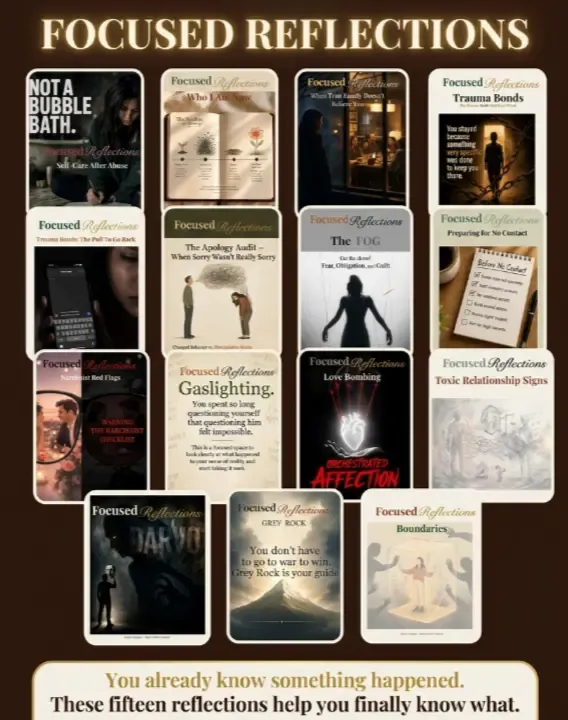
When a relationship has left you carrying too many questions at once, a private workbook can offer one steady place to begin. These fifteen guided reflections help you slow down, notice what keeps repeating, and give your own experience room to be real.
Fifteen private reflections. One question at a time.
When your memory feels crowded
Emotional abuse rarely leaves behind one simple moment. It can leave a pile of conversations that do not quite add up, apologies that seemed to change nothing, and a version of yourself that became smaller in order to keep things calm. You may remember something clearly, then immediately question whether you are being unfair, dramatic, or too sensitive for taking it seriously.
That kind of confusion can make a blank page feel impossible. Where do you start when every memory seems to bring five more with it? A guided workbook gives you a smaller doorway. Instead of asking you to decide what the whole relationship meant, it offers one honest question about one part of what you lived through.
Focused Reflections was made for that slower work. The pages do not ask you to prove anything or rush toward a label. They give you a private place to notice what happened, what changed in you, and what you need in order to feel more grounded in your own perspective.
How the workbook helps
The bundle is built around prompts that help you stay close to your own experience without demanding that you have every answer today.
A workbook can give the moment that keeps returning to you somewhere to land, even before you know how it connects to everything else.
The prompts make room to look at what happened before, during, and after an exchange, including blame, silence, pressure, apologies, or the ways you began to change yourself.
You can write what you saw, felt, needed, or remember without turning the page into a debate you have to win.
Nothing has to be completed in one sitting. A reflection can wait until a new memory, feeling, or question makes it useful again.
A place to begin privately
What is inside
Some days the question may be about what happened in one argument. On another day, it may be about why you started apologizing more, what you no longer felt safe sharing, or why leaving and returning both felt so hard. The reflections are designed to meet those different places without pretending there is one correct order for recovery.
Each worksheet offers a clear starting point and room for your own words. You can write a few lines, leave a question blank, or return to the same page more than once. The value is not in completing every exercise. It is in having somewhere you can put what you notice before it disappears beneath doubt, guilt, or somebody else’s explanation.
Because the bundle is digital, you can choose the reflection that feels closest to today. You are not required to work from the beginning to the end, and you are not behind if you need a pause. Your pace belongs in the process.
The workbook can also help you notice the difference between one difficult moment and a pattern that keeps asking you to adapt. You may begin to see how often you explained yourself, what you learned to avoid, or which needs started to feel too expensive to name. Those observations do not force a conclusion. They simply give your experience a little more shape, so you can return to it with less pressure and more care.
Choose the right kind of space
Focused Reflections offers fifteen prompts for individual questions. My Clarity Journal offers a longer place to document what you notice over time.
A $34 digital bundle for the moments when you need one focused question instead of a demand to tell the whole story.
Get the workbookA guided journal with daily entry pages, pattern prompts, and room to keep hold of what repeats when longer writing feels safe.
Explore the journalLet the questions be small
It is common to wait for total certainty before letting yourself write anything down. You might wonder whether it was really that bad, whether you caused the conflict, or whether you should be over it by now. Those questions can be especially loud after a long period of being blamed, dismissed, or told that your reaction is the real problem.
A workbook cannot decide the truth of your life for you, and it does not need to. Its job is to make room for the questions that keep asking to be noticed. What did you start doing to avoid a reaction? What did you stop trusting about yourself? What became harder to say? What did you need that you kept setting aside?
Small observations can matter. A page may help you see a pattern, remember a detail, or recognize that the version of you who kept trying to make sense of things deserves patience. You can keep only what helps and set down the rest.
If a prompt feels too close to something you are not ready to write about, you can move on. Some people find it useful to circle back after time, distance, or a conversation with someone they trust. There is no prize for pushing through a page before it feels safe. The workbook is there when it serves you, not the other way around.
Frequently asked questions
An emotional abuse workbook gives guided questions and space to write through experiences that can be hard to hold all at once. Focused Reflections includes fifteen private digital worksheets, each offering one place to begin rather than asking you to explain an entire relationship.
It is for readers who are trying to understand a relationship that has left them confused, guilty, on edge, or less connected to themselves. You do not need to be certain about what to call your experience before you use it.
A blank journal offers open space. This workbook offers a starting point when the first sentence feels hard to find. The questions are there to help you stay with one piece of your experience at a time.
No. You can choose the page that fits today, skip any prompt, and return later. The workbook is meant to meet you at your own pace, not become another task to get right.
Safety comes first. If someone monitors your belongings, device, email, or writing, choose the option that creates the least risk. You can read a prompt without answering it, wait for a safer time, or use the support page to find another next step. You can also explore Quinn’s support page for a quieter next step.
Your clarity matters
You do not have to organize your whole history before you give today’s question some care.
Get Focused Reflections