What happened, in your own words
Begin with one moment that has stayed with you. The page makes room for details, feelings, and the parts you are still trying to understand, without asking you to make the whole story fit at once.
Focused Reflections
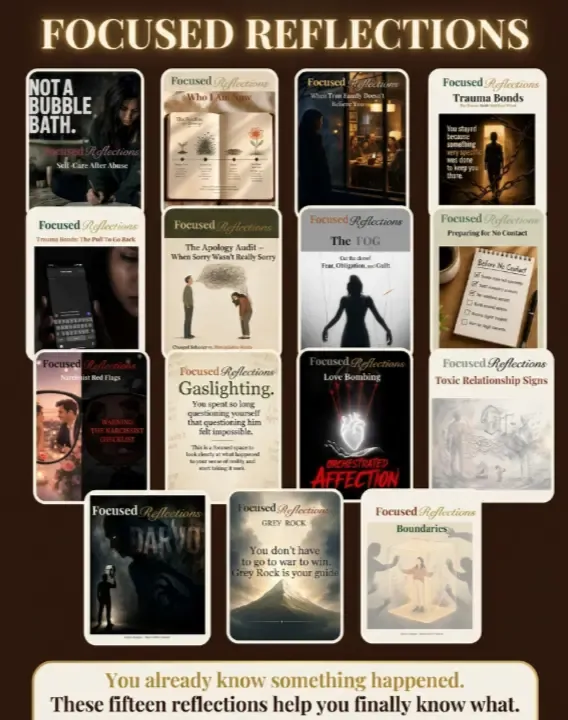
When a conversation keeps getting rewritten, your reaction keeps becoming the problem, or you cannot stop wondering whether you remembered it wrong, one focused page can give the moment somewhere quieter to land. Focused Reflections offers fifteen guided worksheets for the facts, feelings, patterns, and questions you want to hold onto.
Fifteen guided reflections for the questions that keep returning.
When the details will not stay still
Gaslighting can make even a small moment feel difficult to trust. You may remember a sentence, an expression, or the way you suddenly felt responsible for calming someone else down. Then the details are denied, minimized, or replaced with a version that makes you wonder whether you caused the problem in the first place.
A worksheet cannot settle every question for you, and it does not need to. It can give you a private place to slow down with one piece of the experience. What happened before the conversation changed? What did you say you needed? What response did you receive? What did you begin to tell yourself afterward?
Focused Reflections was created for that kind of careful looking. It does not ask you to prove a label, confront anyone, or turn your life into a case file. It gives you one compassionate prompt at a time, so your own observations have somewhere to exist without being interrupted or corrected.
A smaller place to begin
The worksheets make space for reflection without making you explain everything at once.
Begin with one moment that has stayed with you. The page makes room for details, feelings, and the parts you are still trying to understand, without asking you to make the whole story fit at once.
Look at the moments when a concern, boundary, memory, or need became an argument about your tone, your intentions, or your character instead.
Notice the things that became harder to trust, from a memory or reaction to your right to ask a simple question. Naming that shift can be a meaningful place to start.
End with a smaller question about care, privacy, support, space, or time. The point is not to make a decision on the page. It is to make room for your own needs again.
This may be for you
A worksheet is not a verdict
It can be tempting to search for one definitive moment that proves what you lived through. Often, the experience is less tidy than that. There may have been apologies that sounded sincere, days that felt calm, or explanations that made sense just long enough for you to question yourself again. A single worksheet leaves room for that complexity.
Over time, the pages can help you place moments side by side. You may notice what happened when you raised a concern, how often you felt pressured to explain yourself, or which parts of your life began to feel smaller while you tried to keep the peace. You may simply remember that your reaction had a context.
You do not have to complete every reflection, write every day, or come away with a final answer. You can write a few lines, skip a prompt, and return later. The purpose is not to perform recovery correctly. It is to give your experience enough room to be taken seriously by you, without any rush or deadline.
Some prompts may bring up a question you have carried quietly for a long time: Why did I stop saying what I thought? Why did I start rehearsing ordinary requests? Why did an explanation that once felt clear become so hard to trust? You do not need to answer every question. Let the page hold the one that feels possible today.
That can be especially useful after a moment that leaves you feeling embarrassed for having reacted at all. Instead of immediately deciding that you were too sensitive or should have handled it better, you can make room for the full sequence. What was happening before? What did you ask for? How did the conversation change? What did you need afterward? Small details can help you return to your own perspective with more care.
Choose the space that fits
Focused Reflections offers fifteen digital pages for individual questions. My Clarity Journal offers a longer writing practice for the patterns you want to keep close over time.
A $34 digital bundle for the moments when one clear question feels more possible than telling the whole story.
Get the worksheetsA 220-page guided journal with daily entries, pattern prompts, and room to return to what you notice.
Explore the journalSafety comes first
If someone checks your phone, email, accounts, belongings, location, or private writing, pause before saving or printing anything. You do not owe any tool a complete record. You can read a prompt without answering it, hold onto a detail in another way, or come back when you have more privacy.
The pages are here to support your well-being, not to make a difficult situation harder. Take only what helps, move at your own pace, and set the rest aside. If you need a quieter next step, Quinn's support page is there when you need it.
For broader language around the pattern itself, you can also read how gaslighting differs from genuine forgetfulness. When a longer record feels safer and more useful, explore the guided gaslighting journal.
Frequently asked questions
Focused Reflections is a $34 digital bundle of fifteen guided worksheets. Each page offers more room than a quick checklist, so you can return to a question when it feels useful instead of trying to resolve everything at once.
No. The worksheets are for the in-between too. You can begin with the parts that feel familiar and leave the rest, without having to choose a label or make a decision before you are ready.
A blank journal gives you open space. These worksheets offer one focused doorway at a time, with prompts for the details, patterns, and questions that can be difficult to organize when your thoughts feel crowded.
Your safety matters more than completing a page. If someone checks your devices, belongings, email, or private writing, use only what feels safe enough, or leave the worksheets for another time.
Your clarity matters
You do not have to organize your whole history before you give one honest question some room.
Get the worksheets