A personal note from Quinn
Every Checklist Asked Me About Him
Some signs of emotional abuse are not obvious rules, threats, or insults. They can show up in what you begin doing automatically to avoid a reaction.

Written August 2026.
I took every quiz.
Does he yell at you. Does he check your phone. Does he control the money. Does he tell you what to wear, who you can see, where you can go. Does he call you names. Does he threaten you.
No. No. No. No. No. No.
I remember the particular feeling of reaching the bottom of one of those lists. Not relief. Something closer to being dismissed. I had gone looking for an explanation and been told, politely and in bullet points, that whatever this was, it was not that.
So I closed the tab. And I went back to a life in which I had, that same week, spent two days working out how to mention a work party.
The list nobody wrote
Here is what none of those quizzes asked me.
Do you rehearse sentences before you say them out loud.
Do you check his face before you answer a simple question.
Do you decline things before anyone has objected to them.
Do you already know the answer, so you have stopped bringing things up at all.
Every one of those was a yes. Every one had been a yes for years. And not one of them appeared on a single list, because every list was pointed in the wrong direction.
By the time you start explaining him, you have already shrunk yourself
That is the sentence I wish someone had put in front of me.
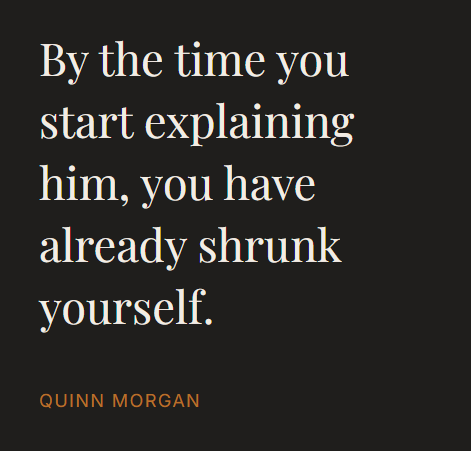
Those checklists ask you to build a case. They hand you the charges and send you looking for evidence, and the evidence has to be in him, because that is where they told you to look. Did he do this. Did he say that. How many times. How bad was it.
Think about what that actually requires of you.
It requires you to prosecute someone you may still love. It requires you to reach a verdict before you are permitted to feel anything. And it requires you to do all of it using your own memory, which is the one instrument that has been under negotiation this entire time. He remembers it differently. He remembers it calmly. He is not the one crying, so he must be the one thinking clearly.
Most of us fail that test on purpose. I know I did. Every time I got close to answering yes to something, I found the context that turned it back into a no.
The evidence was never in him
It was in me.
It was in the rehearsing. In the predicting. In the long, completely invisible list of things I had stopped mentioning, not because anyone told me to stop, but because I had gotten good enough at guessing the outcome that bringing them up started to feel inefficient.
Nobody had to control me. I was doing it myself, and I was doing it so smoothly that it registered as a personality trait. It felt like knowing my partner well. It felt, and I want to be precise about this, like being considerate.
That is the thing about the quiet version. There is no scene. There is nothing you could describe to a friend without it sounding like nothing at all. There is only a slow, agreeable narrowing that you carry out with your own hands.
The question was never what is he doing to me
I could not answer that one. I am still not sure I can answer it cleanly, and I have been out for a while now.
The question I could answer, the first time it was ever put to me, was a different one.
Who did I become to keep the peace.
I knew that answer immediately. I had known it for years without ever once putting it into words, because nobody had asked, and because the asking turns out to be the whole thing.
If you are reading the lists and coming up with nothing, I am not going to tell you that means something is wrong.
I am going to tell you that the lists are looking at him.
Look at yourself for a minute instead. Not at what happened. At what you do now, automatically, without deciding to.
That is where mine was the entire time.
Keep reading