The Recovery Room
How to Resist Intermittent Reinforcement
When relief keeps arriving after hurt, a gentle guide to stepping back from the pattern without shaming yourself.
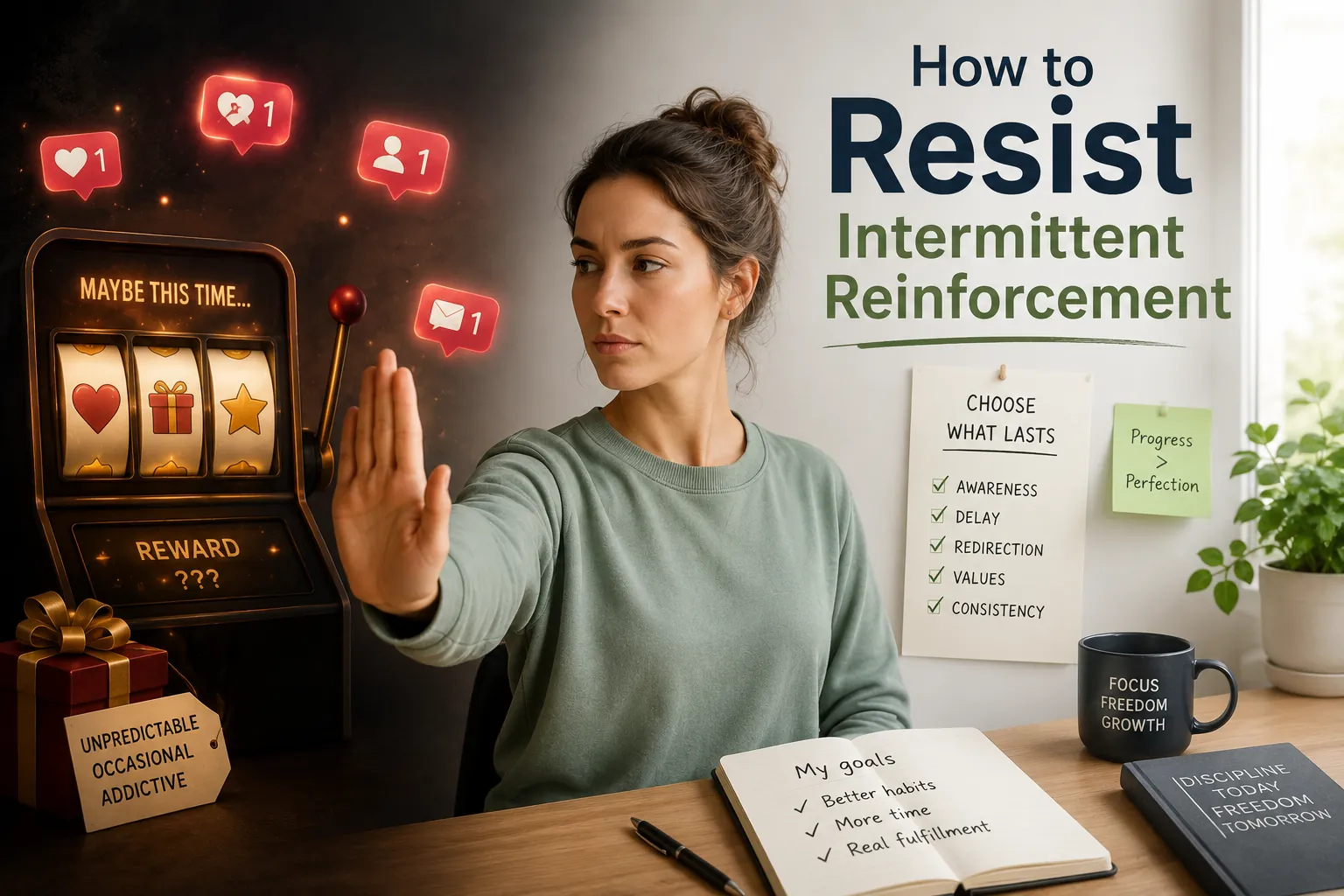
The message comes after days of silence. Or after a cruel argument, a sudden apology arrives with the exact tenderness you have been missing. Your body loosens before your mind can catch up. If you are trying to understand how to resist intermittent reinforcement, start here: that pull does not mean you are foolish, disloyal, or unable to see what is happening. It means your nervous system has learned to wait for relief.
Intermittent reinforcement is one reason an emotionally harmful relationship can feel so difficult to step back from, even when you can name the pattern. The kindness is not always absent. That is what makes it confusing. There may be affection, promises, calm mornings, thoughtful gestures, or moments when he seems to understand you completely. Then the tension returns. The criticism returns. The rules shift. You are left trying to get back to the version of him who felt safe.
This is not a failure of logic. It is a pattern that trains hope to stay alert.
What intermittent reinforcement actually does
When warmth and pain are unpredictable, your mind begins scanning for the next sign that things will be okay. You may reread messages, replay conversations, adjust your tone, or search for the one thing that might bring back the peace. A small kind gesture can feel enormous because it arrives after fear, distance, or confusion.
Over time, the relationship can begin to feel like a problem you must solve. If you can just say it better, be calmer, ask less, need less, or forgive more quickly, maybe the good version will stay. But the issue is not that you have failed to find the right combination of words. The instability itself keeps you focused on earning the next moment of relief.
That is why a promise after harm can feel more convincing than the harm itself. Your body is responding to the end of distress, not necessarily to evidence of lasting change.
How to resist intermittent reinforcement without shaming yourself
Resisting the pattern does not mean you must stop loving someone on command. It does not require you to make a public declaration, confront him, or decide everything tonight. It means creating a little space between the feeling of relief and the decision you make because of it.
The goal is clarity before action. Sometimes clarity begins with one quiet sentence: “This feels good right now, but I need to look at the whole pattern.”
Separate the moment from the pattern
When an apology, affectionate text, or peaceful weekend makes you question everything, do not argue with yourself about whether the moment is real. It may be real in that moment. Instead, ask a different question: What usually happens next?
Look beyond the apology to what follows it. Is there accountability without blame? Does he name what he did without turning it back on you? Does the change continue when he is disappointed, stressed, or not getting what he wants? Does your body feel less watchful over time, or are you simply waiting for the next shift?
A loving moment does not erase a repeating pattern. Both things can be true: he can be kind sometimes, and the relationship can still be harming you.
Keep a record for the version of you who will doubt herself
Intermittent reinforcement works partly because memory can become organized around the latest event. After a warm message, you may struggle to remember why you were so hurt two days ago. After an argument, you may remember only the tenderness and feel guilty for questioning it.
A private record can give you something steadier than the emotional weather of the day. Keep it somewhere he cannot access if that is safe for you. Write the date, what happened, what was said, how your body felt, and what happened after you expressed a need or boundary.
You do not need to write a polished account. A few plain lines are enough: “He called me selfish after I asked about the bill. Later he brought dinner home and acted as if nothing happened. I felt relieved, then ashamed for still being upset.”
The purpose is not to build a case for anyone else. It is to help you see the sequence when your mind has been pulled toward one isolated good moment.
Give yourself a pause before you respond
The urge to answer immediately can be intense, especially after silence or conflict. A message may feel like proof that you still matter, or like your one chance to get things back on track. If it is safe to do so, create a small delay between receiving contact and responding.
This might be ten minutes at first. Put your phone down. Drink water. Stand near a window. Read your notes. Ask yourself, “What do I want to say when I am not trying to stop the discomfort?”
A pause is not a game. It is a way of returning your choice to yourself. If delaying a response could increase risk in your situation, your safety comes first. Quietly adapting to what keeps you safer is not giving in. It is paying attention to your reality.
Let your body have a vote
Your mind may have many reasons to accept the explanation you are being offered. Your body often holds information that has not yet become a clear sentence. Notice what happens after contact, not only during it.
Do you sleep? Can you eat? Do you feel settled, or do you feel compelled to monitor his mood? Are you bracing for the next accusation, withdrawal, or demand? Relief can feel like love when you have been carrying fear for a long time. They are not the same thing.
Try this prompt after a good moment: “If nothing changed beyond today, could I live with this cycle for another year?” You do not have to answer perfectly. Let the question sit beside you.
Build other places for your mind to land
The pattern becomes more powerful when his attention is the only thing that calms you. This is not a criticism. Isolation, secrecy, and chronic stress can narrow your world until one person’s mood seems to determine whether you can breathe.
Choose one outside anchor that is private and realistic. It could be a trusted friend who does not pressure you, a counselor familiar with relationship abuse, a support line, a journal you return to each morning, or a regular walk where you let yourself think without interruption. You are not required to tell the whole story at once. You can begin with, “I am confused about what has been happening, and I need someone to listen without telling me what to do.”
If you have been told that no one will understand, notice that message too. Isolation often makes intermittent reinforcement stronger because the relationship becomes the only source of comfort after the relationship causes the pain.
Grieve the version you keep waiting for
This part is tender. Often, what you are resisting is not only his latest message or promise. You are resisting the hope that the person you first knew, or the person he sometimes appears to be, will finally become consistent.
Grief may sound like: “I miss who I thought we could be.” It may sound like anger, numbness, bargaining, or a deep wish to be proven wrong. You do not need to shame that hope out of yourself. But you can stop letting hope make every decision alone.
Ask: “What am I being asked to give up in order to keep believing this time will be different?” Maybe it is your sleep, your friendships, your sense of reality, your money, your privacy, or your ability to speak freely. Write the answer down without arguing with it.
When resisting needs a safety plan
For some women, stepping back changes the level of risk. If he monitors your phone, controls money or transportation, threatens consequences, escalates when you set limits, or makes you afraid of what he might do, focus on safety rather than trying to prove a point. You do not owe him a confrontation or an explanation.
Consider what private support, documents, access to money, transportation, medication, or a safe person might matter if you need them. If you are in immediate danger, contact local emergency services when you can do so safely. Your situation may require careful, quiet planning, and that does not make your need for clarity any less real.
The next kind message may still stir something in you. That is okay. You do not have to punish yourself for feeling the pull. Just let the whole pattern speak, not only the moment that asks you to forget it. You are allowed to trust the part of you that has been trying, quietly and faithfully, to tell you the truth.