The Recovery Room
Why Does He Deny Everything? What It May Mean
When he denies what happened, the confusion can be the point. A gentle guide to noticing the pattern and returning to your own experience.

You may be asking, why does he deny everything, after another conversation that left you holding the facts in one hand and his complete refusal in the other. Maybe he says it never happened. Maybe he says you misunderstood his tone, remembered it wrong, started it, or are making too much of something small. And somehow, by the end, you are the one apologizing.
That kind of confusion is not a sign that you are incapable of understanding what happened. It is often what happens when someone repeatedly refuses to share reality with you.
Why does he deny everything?
Sometimes people deny hurtful behavior because they feel shame, fear consequences, or do not know how to tolerate being wrong. A single defensive response does not tell you everything about a relationship.
But there is a difference between someone saying, “I did not realize that hurt you. I need a minute, but I want to understand,” and someone who routinely erases, reframes, and reverses what happened.
When denial is part of a larger pattern, it can protect his comfort at the expense of your clarity. If he admits he yelled, lied, insulted you, broke an agreement, or frightened you, he may have to face what that says about his behavior. Denial gives him a way out. It moves the attention away from what he did and onto whether you can prove it well enough.
That is an exhausting position to live in. You begin entering every conversation like a courtroom, collecting details, replaying wording, and wondering whether you have enough evidence to earn the right to be hurt.
You do not have to win a case to honor your own experience.
The forms denial can take
Denial is not always a flat, outright “That never happened.” Often, it is more slippery than that. He may admit a small piece while denying the part that matters most. He may say, “Yes, I said it, but you made me say it,” or “I only did that because you pushed me.”
He may turn the conversation toward your reaction. Suddenly, the original issue disappears under questions about your tone, your timing, your memory, or your character. You came to talk about the message he sent, the money he withheld, or the way he spoke to you in front of the children. Now you are defending why you brought it up at all.
He may also rewrite the meaning of what happened. “I was joking.” “You know I did not mean it that way.” “You are too sensitive.” These phrases can sound ordinary in isolation. What matters is whether they become a reliable way of making your pain irrelevant.
A relationship can hold misunderstandings. It cannot hold much safety when one person gets to decide, every time, what reality is and whether the other person is allowed to feel it.
What accountability sounds like
Accountability does not require two people to remember every detail in exactly the same way. It does require room for impact. A person can say, “I remember it differently, but I can see that it hurt you,” or “I was upset, but I should not have called you that.” They can return to the subject after a pause instead of making the pause another way to avoid it.
It also shows up after the conversation. Does the apology lead to a change in behavior? Does he respect the boundary next time? Can you raise a concern without bracing for punishment, mockery, or days of silence? Repair is not about finding perfect words. It is about taking responsibility seriously enough that you do not have to keep carrying the same injury alone.
That does not mean someone will get everything right immediately. It means the relationship has enough honesty for both people to remain real inside it. You should not have to become smaller, quieter, or less certain of yourself in order for peace to be possible.

Watch the pattern, not the explanation
It is understandable to search for the perfect explanation. Is he stressed? Was his childhood difficult? Does he truly not remember? Is this just how couples argue?
Those questions can keep you circling for a long time because some of them may have complicated answers. You may never know exactly what is happening inside him. But you can learn a great deal by looking at what happens to you after he denies something.
Ask yourself: Do I leave conversations clearer or more confused? Does he make room for my perspective, even when he disagrees? When I bring up harm, does he become accountable, or do I end up comforting him? Do I feel pressure to abandon what I know in order to restore peace?
The explanation matters less than the repeated impact. If a pattern leaves you doubting whether what you are experiencing is abuse, minimizing your own fear, and working harder and harder to make basic reality acceptable to him, that pattern deserves your attention.
This is especially true when the denial follows behavior that crosses your boundaries. You may hear a sincere apology after a blowup, only for him to later deny the blowup occurred. You may be told he understands, then be accused of inventing the issue the next time it happens. The apology can make you hope. The denial can make you question whether hope was foolish.
Neither response changes what you lived through.
Why arguing harder rarely brings clarity
When someone is committed to denying, more explaining often does not create more understanding. It can create more openings for him to pick apart your words.
You may arrive with dates, screenshots, exact phrases, and a calm voice. He may still dispute the date, the context, the wording, your reason for saving the message, or the expression on your face when it happened. The conversation becomes less about repair and more about wearing down your confidence.
This does not mean you failed to explain yourself properly. It may mean the conversation was never being held in good faith.
You are allowed to stop trying to persuade someone who benefits from misunderstanding you. That can be a quiet internal shift, not a confrontation. You might tell yourself, “He does not have to agree for this to matter to me.”
That sentence is not a demand that you make any immediate decision. It is a way of returning your own experience to its rightful place.

A private way to find your footing again
If your memory feels foggy, create a record for yourself, not for an argument. Keep it somewhere he cannot access. After an incident, write the date, what was said or done, what happened before and after, and how you felt in your body.
Keep it plain. You do not need polished language. “He said he never called me names. On Tuesday, he called me worthless during the drive home. I went quiet. Later, he said I was imagining his tone.” That is enough.
Over time, notes can help you see what is hard to see while you are inside it: repetition. They can show whether the denial is occasional defensiveness or part of a cycle where harm is followed by refusal, blame, affection, and another reset.
You might also separate facts from the messages you absorbed afterward. On one side of a page, write what occurred. On the other, write what he said it meant. For example:
What occurred: He read my private messages after I asked him not to.
What I was told it meant: I should not have anything to hide, so my boundary was suspicious.
That space between the event and the explanation is often where clarity begins. You can see that a boundary existed before anyone argued about whether you deserved one.
When denial is paired with fear or control
Take the pattern seriously if his denials come with intimidation, monitoring, threats, financial restriction, isolation, pressure around sex, destruction of belongings, or fear about how he will react if you disagree. You do not need to announce what you are noticing or confront him with your notes.
Your safety and privacy come first. Consider speaking with a trusted person from a safe device, making copies of essential documents if that is safe, or contacting The National Domestic Violence Hotline for confidential options tailored to your circumstances. If you are in immediate danger in the U.S., call 911.
There is no one correct timeline. Some women need to focus first on getting through tonight, protecting their children, keeping their work stable, or gathering information quietly. Clarity before action is still movement. It is how you begin trusting the part of you that has been trying to get your attention.
You are allowed to believe what you experienced
His denial may be loud, confident, tearful, angry, or delivered so casually that you question yourself for days. None of that makes it true.
You are not asking for too much when you want honesty, repair, and room for your reality in the relationship. Start small if that is all you can do right now: write down one incident without editing it to make him look better. Read it later. Notice what becomes clearer when you let your own memory have a voice.
Frequently asked questions
When denial leaves you holding the facts alone.
Why does he deny things that clearly happened?
People can deny because they feel ashamed, fear consequences, or do not know how to tolerate being wrong. What matters most is the repeated impact. When denial regularly moves attention away from the harm and onto whether you can prove it, your clarity is being asked to carry the cost.
Is denial always gaslighting?
Not every disagreement or imperfect memory is gaslighting. The concern is a pattern in which your memory, feelings, or right to name harm are repeatedly dismissed until you no longer trust yourself. You do not need a label before you take that pattern seriously.
How can I tell the difference between a disagreement and a harmful pattern?
A disagreement can still leave room for both people to be heard, take a break, and come back to the original issue. A harmful pattern keeps making your perspective the problem. Notice whether you can raise hurt without being punished, whether apologies lead to change, and whether you leave feeling clearer or more confused. You do not need to reach a final conclusion before you let those answers matter to you.
What can I do when he denies everything?
You do not have to persuade him in the moment. If it is safe, write down what happened for yourself, return to the original concern, and speak with someone who will not pressure you into a decision. If denial comes with fear, threats, monitoring, or control, your privacy and safety come first.
Keep reading
More language for what is hard to name.
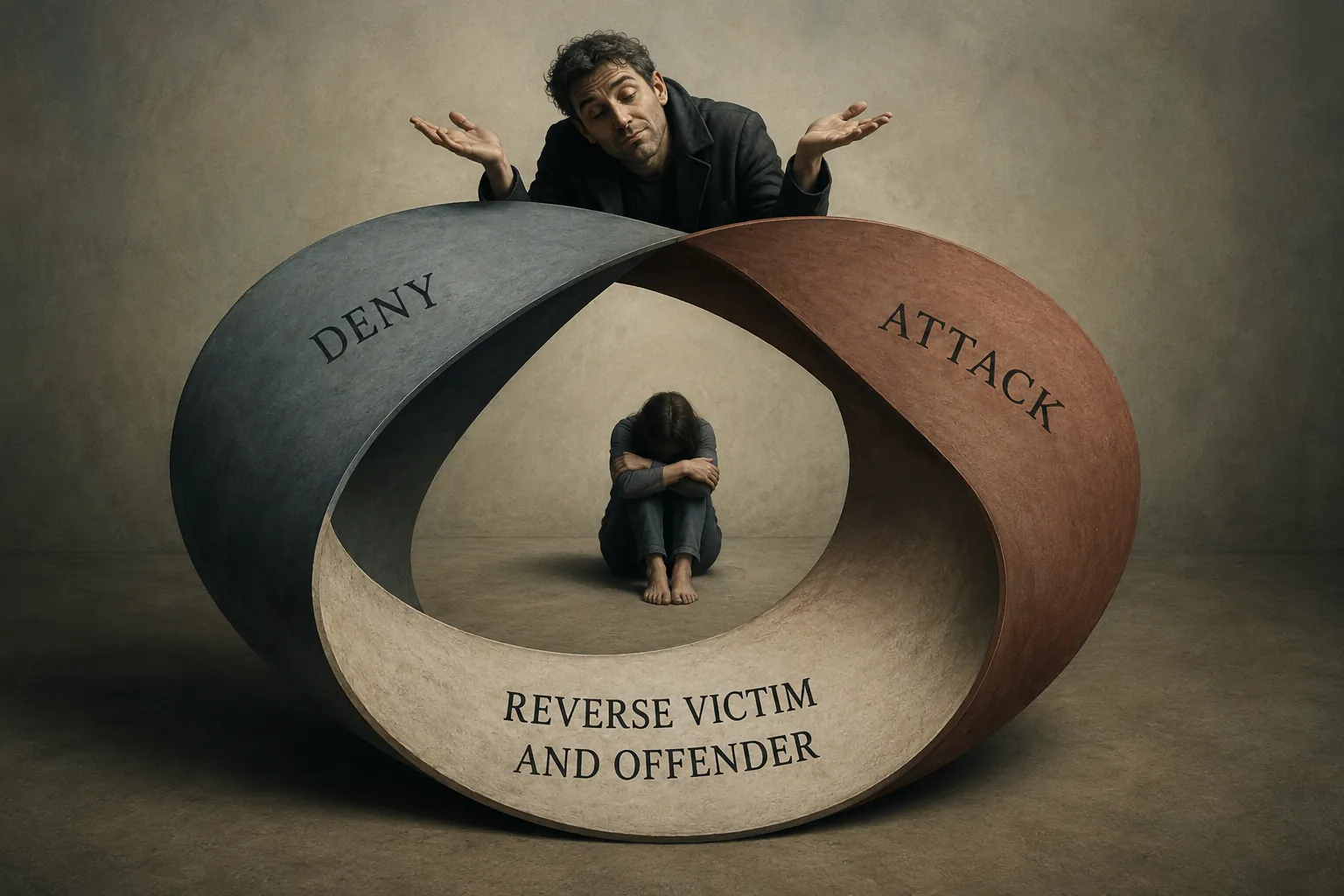
What Does DARVO Mean? A Clear Guide
When a concern becomes their hurt, understand the reversal and find a calmer way back to your own experience.
Read the guide →
Gaslighting Versus Genuine Forgetfulness
A missed detail can happen. What matters is whether there is room for your memory and real repair.
Read the guide →
Why Do I Feel Crazy After Arguments?
When arguments leave you foggy or ashamed, learn what to notice and how to regain your footing.
Read the guide →