Recognition
Use a detailed checklist and guided prompts to notice control across communication, time, money, privacy, relationships, work, decisions, and your right to disagree.
The Invisible Cage
When fear, rules, monitoring, isolation, or pressure have begun shaping your days, it can be hard to see the whole pattern while you are living inside it. This private guided workbook gives you a place to notice what changed, what it cost you, and what you want to begin bringing back into your own life.
A private guided workbook for recognition, impact, and reclaiming.
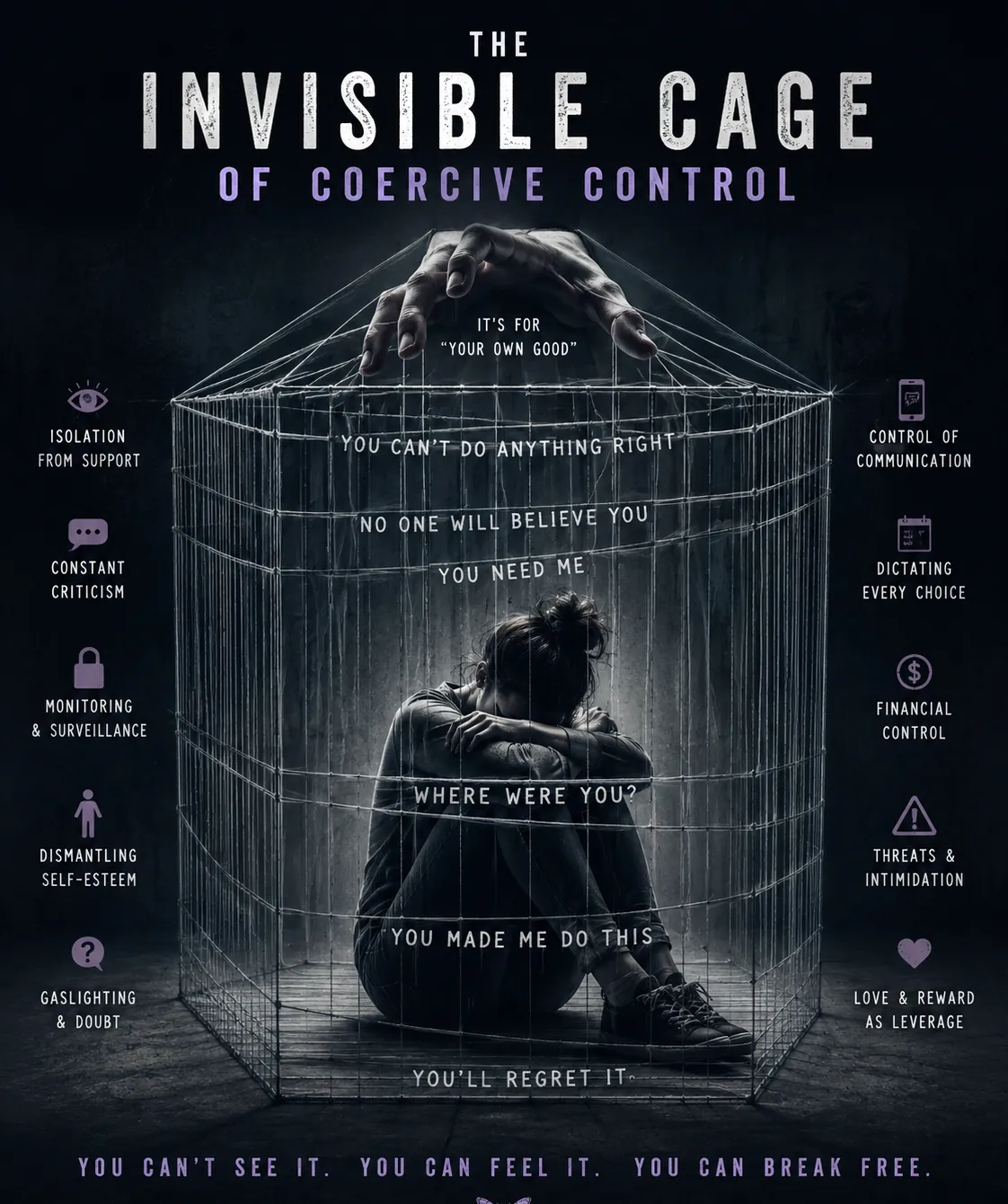
When your life keeps getting narrower
Coercive control often builds through moments that are easy to explain one by one. You may start sharing your location to prove you are trustworthy, changing plans to avoid a fight, leaving friends unanswered, accounting for money, or learning which opinions will turn into hours of conflict. Each adjustment can feel small. Together, they can change how much room you have to be yourself.
The hardest part may be that no one rule seems large enough to name what has happened. There may be warmth, apologies, affection, or periods when things are calm. You may wonder whether you are being unfair for noticing the fear beside those moments. But a useful question is not only what they intended. It is what the pattern required of you.
The Invisible Cage gives you a structured place to look at that question. You can begin with one behavior, one cost, or one choice that no longer feels like yours. You do not need to call the relationship anything before you are ready. You only need enough privacy and space to notice what your life has been asking of you.
Inside the workbook
The workbook follows the order that can make a difficult experience easier to hold: recognition, impact, then reclaiming.
Use a detailed checklist and guided prompts to notice control across communication, time, money, privacy, relationships, work, decisions, and your right to disagree.
Look beyond individual incidents to what the pattern may have cost you: routines, friendships, confidence, calm, independence, interests, or trust in your own reactions.
Work through four structured prompts for the choices, boundaries, relationships, and parts of yourself you want to begin making room for again.
A private place to notice
Start with what repeats
Control does not need to look the same every day to have an effect. There may be criticism when you see a friend, monitoring after you ask for privacy, pressure when you spend money, or an argument whenever you make a plan without permission. The details may change, but the result can stay the same: your choices get smaller because staying safe or keeping the peace takes more and more of your attention.
The recognition pages are designed to help you look across that repetition. You can map what happens before a difficult moment, how you change yourself to respond, what happens when you say no, and what the relationship asks you to give up to make things feel calm again. You do not need every answer today. Sometimes seeing the question written down is enough.
This is not an invitation to confront someone or prove anything to anyone. It is a chance to hear your own observations without interruption. A pattern may become easier to understand when you stop asking whether one moment was bad enough and start noticing what you had to do, over and over, to live around it.
The impact pages make room for what can disappear quietly: an interest you stopped mentioning, a friend you saw less often, a route home you changed, a decision that became too exhausting to make, or a version of yourself that felt easier to access before the relationship narrowed. You can name those losses without needing to minimise them because they were gradual. A smaller life is still a loss, and it is worth noticing with care.
A guided place to begin
The Invisible Cage is a $6 digital workbook. It gives you a private, structured place to move through recognition, impact, and reclaiming without forcing a conclusion or a timeline.
Use the workbook when you need clearer language for pressure, monitoring, fear, isolation, and the slow loss of room to choose for yourself.
Get The Invisible CageWhen regular writing feels safe, My Clarity Journal offers guided space for facts, feelings, repeated patterns, and the details you want to keep close.
Explore My Clarity JournalReclaiming can begin quietly
After a long time of anticipating someone else's response, even an ordinary preference can feel unfamiliar. Reclaiming might mean remembering which friend you miss, what you used to enjoy, what you want to wear, how you want to spend an afternoon, or what it feels like to make a decision without rehearsing the consequences first.
The final prompts in The Invisible Cage make room for those smaller returns. They do not turn recovery into a performance or ask you to move faster than feels possible. The aim is not to prove strength by reaching a perfect ending. It is to notice where your life has become constrained and consider what could help you have more room in it.
If someone is monitoring your devices, restricting your money, threatening you, blocking you from leaving, or becoming more volatile when challenged, safety matters more than completing a workbook. You can take only the parts that feel safe, use a safer device when you need support, and leave the rest for another day. Quinn's support page is available when you need a quieter next step.
Frequently asked questions
The Invisible Cage moves through recognition, impact, and reclaiming. It includes a detailed behavior checklist, prompts to map a pattern across your relationship, reflections on what control has cost you, and four structured prompts for making room for your own choices again.
No. It is also for the in-between, when you are trying to understand what has been happening or what you need next. It does not ask you to make a decision before you are ready.
No. You can begin with the questions that feel familiar and leave the rest. The workbook is a private place to notice your own experience, not a test you have to pass.
Put safety first. If someone checks your devices, email, bag, or private writing, choose the option that creates the least risk for you. This workbook is a private tool, not emergency support.
Your clarity matters
Begin with one repeated moment, one cost, or one choice you want to remember is yours.
Get The Invisible Cage