Guided daily entries
Use prompts for what happened, what was said, how you felt, and what you know now. Write a few lines or take up the whole page. The structure is there when finding the first sentence is the difficult part.
My Clarity Journal
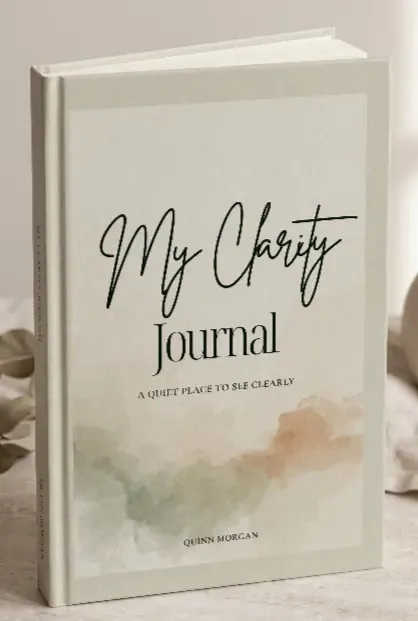
When you keep replaying an argument, questioning what was said, or wondering why your version of a moment feels so hard to trust, a private record can give you somewhere steady to return to. My Clarity Journal offers guided pages for the facts, feelings, patterns, and questions you want to keep close.
220 guided pages for noticing what happened in your own time.
When the details keep shifting
Emotional abuse can make ordinary moments difficult to hold onto. You may remember a look, a sentence, the way your body went quiet, or how quickly the conversation became about your flaws instead of the concern you raised. Then an apology, a denial, or a calmer day can make you wonder whether you made too much of it.
My Clarity Journal was created for the parts of the story that are easy to dismiss when you have nowhere to put them. It gives you a structure for recording what happened, how it affected you, and what changed afterward. You do not have to write perfectly, explain everything at once, or decide what any one entry means.
The journal is not a case file and it is not a demand to confront anyone. It is a private place to let your experience exist without being corrected. Sometimes that begins with a date. Sometimes it is one sentence you do not want to lose. Sometimes it is simply admitting that a pattern has been making you feel smaller than you used to be.
Inside the journal
Each part gives you a clear place to begin, without asking you to turn your life into a neat story.
Use prompts for what happened, what was said, how you felt, and what you know now. Write a few lines or take up the whole page. The structure is there when finding the first sentence is the difficult part.
Find language for patterns such as gaslighting, blame shifting, love bombing, isolation, and emotional manipulation when the experience has been clearer than the words for it.
Look across what repeats instead of measuring your experience by one good day, one apology, or one version of events that changed after the fact.
Return to clear definitions when you need a calmer way to name an experience that has been minimized, denied, or made to feel unreal.
A private pace
What a record can hold
It is common to focus on the single moment that seems easiest to question. Maybe you were tired. Maybe they were under pressure. Maybe you could have said it differently. Those details can matter, but they can also make it hard to see the larger pattern: what happened when you disagreed, asked for privacy, made plans, spoke to a friend, spent money, or needed comfort.
Writing can help you set the moments beside one another without forcing a conclusion. You may notice that the same concern keeps becoming your responsibility. You may see how often you prepared for someone else's reaction before you allowed yourself to have one. You may only learn that your body has been bracing for longer than you realized. None of that requires you to decide what happens next today.
My Clarity Journal makes room for the facts and the impact together. It is not about documenting every word or filling every page. It is about giving yourself a place to come back to when a difficult moment gets blurred by distance, pressure, or another explanation that asks you to leave your own experience behind.
You can return to an entry after a few hours or a few weeks and ask smaller questions: What happened before this? What did I need? What changed after I spoke? Did I feel freer, smaller, calmer, or more afraid? Those questions do not turn your experience into a verdict. They can simply help you notice the conditions you have been living with, especially when you have become used to treating your own discomfort as something to explain away. You never need to use the journal every day for an entry to matter. There is no deadline for making sense of it.
Choose your edition
Both editions include the same 220-page guided journal for $23. Choose the format that feels most comfortable for the place and pace where you write.
A bound edition for returning to your notes whenever you need to.
Choose hardcover editionA lay-flat format for writing through one moment, one memory, or one pattern at a time.
Choose spiral editionSafety comes first
A journal can be useful only when it is safe enough to use. If someone monitors your phone, email, belongings, accounts, location, or time, consider whether a written record could create more risk. You do not owe any tool your safety, and you do not need to keep notes to take your own experience seriously.
You can read a prompt without answering it. You can hold onto a detail in another way. You can wait until you have more privacy or leave the journal for another time. The point is not to produce a complete record. The point is to support your well-being, at a pace and in a way that does not put you in a harder position.
For moments when one focused question feels more manageable than a longer journal, Quinn's Focused Reflections workbook offers fifteen guided pages. If you need broader language before you write, you can also begin with the emotional abuse recovery guide.
Frequently asked questions
No. My Clarity Journal includes guided entry pages, behavior checklists, a plain-language glossary, pattern prompts, and quiet wisdom pages between entries. It gives you a place to start when a blank page feels too open.
No. You can use the journal while you are still sorting through what you experienced. It is a place to notice details and patterns in your own words, not a test that asks you to prove a label or make a decision.
Both editions contain the same 220-page guided journal. Choose hardcover for a bound keepsake edition, or spiral when a journal that lies flat feels more comfortable for writing.
Put safety first. If someone checks your belongings, devices, email, or private writing, choose the option that creates the least risk for you. This journal is a private tool, not emergency support. You can also visit Quinn's support page for a quieter next step.
Your clarity matters
Begin with one detail, one feeling, or one question you want to make room for today.
Choose your edition