Start with language
Read Why You Felt Crazy when the hardest part is finding words for the confusion, self-doubt, and changing reality you have been carrying.
Your Clarity Matters
When a relationship has left you questioning yourself, missing someone who hurt you, or trying to understand why you changed, the next step does not have to be a big one. You can begin with language, one private reflection, or a place to keep hold of what happened.
Words, reflections, and room to move at your own pace.

When you are still sorting it out
Emotional abuse can leave behind questions that do not fit into a simple before-and-after. There may have been love beside fear, apologies beside the same repeated harm, or good moments that make you wonder whether the difficult ones count. You may be trying to make sense of something while part of you is still hoping it can be different.
That uncertainty does not mean you are making too much of it. It can be hard to hear your own voice when your feelings, memory, or reactions have been questioned for a long time. Sometimes the first relief is not an answer. It is having a quieter place to put down what has been hard to carry alone.
Quinn's books and private writing tools were made for that place. They do not ask you to prove a label, confront anyone, leave before you are ready, or make a final decision. They give you different ways to stay close to your own experience, one page at a time.
Choose the kind of support you need
Each resource serves a different moment, so you can choose what feels useful without forcing yourself into someone else's timeline.
Read Why You Felt Crazy when the hardest part is finding words for the confusion, self-doubt, and changing reality you have been carrying.
Use Focused Reflections when a blank page feels too open and one thoughtful prompt would make it easier to notice what has repeated.
Choose My Clarity Journal when you need a longer place to write down facts, feelings, patterns, and the things you do not want explained away.
You can read, write, pause, skip around, or come back later. There is no required order and no decision you have to make because you began.
This may be a useful place to begin when you are...
What recovery can look like
For some people, the first piece is a sentence that finally describes what an argument felt like. For others, it is noticing a pattern in their own notes, remembering a moment they had dismissed, or realizing that they have been making themselves smaller to avoid another reaction. These moments can be quiet, but they matter.
Recovery is not a test of whether you leave quickly, stop missing someone, or tell the story in a way that makes sense to everyone else. It can be the slower work of coming back to your own reactions and needs after they have been pushed aside. You are allowed to move carefully, change your mind, or take a pause.
The right tool is simply the one that gives you enough room to notice what is true for you today. A book can offer language. A prompt can make a first sentence possible. A journal can help you return to the details when the story starts to shift again.
These are different kinds of support, not different levels you have to earn your way through. Reading can help when you need to feel less alone in what has been hard to explain. A guided reflection can help when one piece of the story keeps returning. A journal can help when you want to see how moments, feelings, and patterns connect over time. You can stay with the one that feels right, combine them, or set everything down until another day.
Choose your private starting point
There is no wrong place to start. Choose the resource that meets the question you are carrying now.
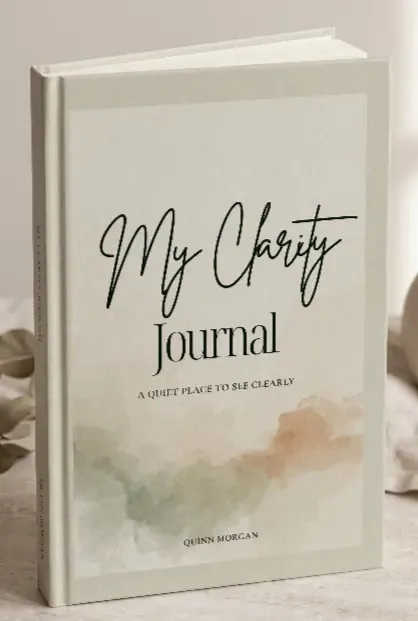
A 220-page guided journal for facts, feelings, behavior checklists, and the patterns you want to keep clear over time.
Explore the journal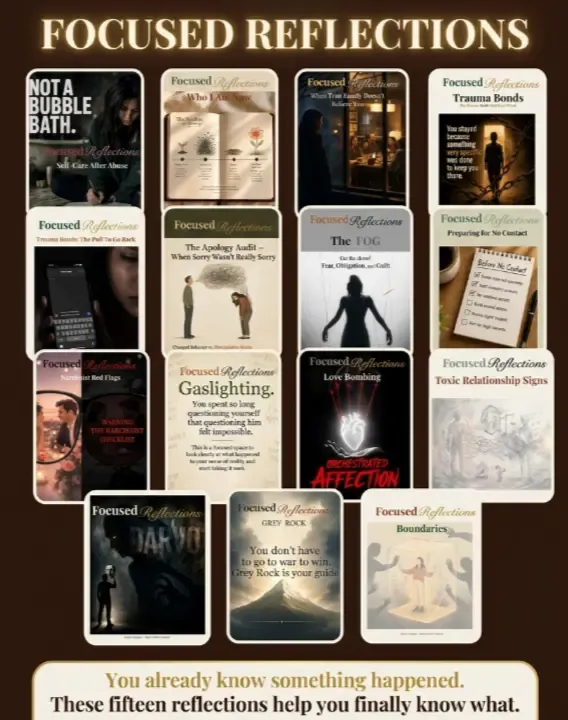
Fifteen guided digital worksheets for the moments when one focused question feels more possible than telling the whole story.
Explore the reflectionsA private pace is still progress
You may need to read something quietly before you are ready to write. You may need to write one detail down before you can name the pattern. You may only be ready to admit that a relationship has changed how you feel about yourself. All of those places are real places to begin.
Quinn's work stays close to the questions that can be hardest to say out loud: Why do I still miss them? Why did I keep apologizing? Why did I stop trusting what I knew? Why does leaving feel different from simply knowing something was wrong? You do not need to answer every question before one of them can matter.
Take what helps. Leave what does not fit. You do not have to choose the perfect resource or use it perfectly for it to be useful. You can come back to the same page more than once, or find that a different resource meets you better later. If anything about your situation feels unsafe, choose the step that protects you most. These resources can support private reflection, but they are not emergency support. Your safety and wellbeing come first.
Frequently asked questions
No. These resources are for the uncertain place too, when you know something changed in you or the relationship but you are still trying to understand what happened.
Start with the free first chapter when you need language and perspective. Choose Focused Reflections when one guided question feels more useful than more reading, or My Clarity Journal when you want room to keep notes over time.
No. They are also for the in-between, whether you are still in the relationship, have left, have gone back, or are simply trying to hear yourself more clearly.
Put safety first. If someone checks your devices, belongings, email, or private writing, choose the option that creates the least risk for you. These resources are private tools, not emergency support. You can also visit Quinn's support page for a quieter next step.
Your clarity matters
Begin with the free first chapter, then take the next step only when it feels useful.
Read the first chapter free