Guided entry pages
Start with what happened, how it felt, what you needed, and what stayed with you afterward. The prompts help when finding the first sentence feels like the hardest part.
My Clarity Journal
When a relationship, a season of loss, or too many difficult conversations have made it harder to hear your own voice, writing can offer a quieter place to return. My Clarity Journal has 220 guided pages for the feelings, details, and patterns that deserve more room than a passing thought.
220 guided pages for healing without pressure to have it all figured out.
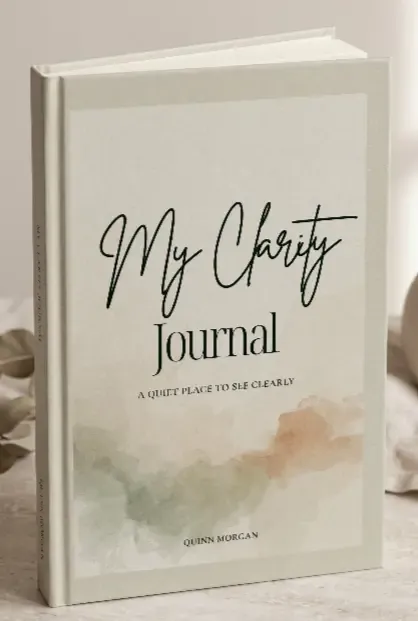
A place to put what stays with you
Healing can begin before you know exactly what to call what happened. It can begin with the lingering feeling after a conversation, the memory you keep revisiting, or the realization that you have become used to setting aside your own needs. A journal cannot solve every question, but it can give the question somewhere to rest long enough for you to hear it.
My Clarity Journal was created for that kind of return. Its pages help you place the facts, feelings, and aftermath beside each other without asking you to make them neat. You can write about one moment, an old pattern, a boundary you wish had been respected, or a part of yourself you want to know again. There is no right amount to write and no correct way to heal on the page.
This is not a journal that asks you to be positive, forgive on schedule, or turn pain into a lesson before you are ready. It is a structured place to be honest with yourself. Sometimes that honesty is a full page. Sometimes it is one sentence that says, this mattered to me.
Inside the journal
Each part gives you a smaller way in, while leaving the meaning of your experience in your hands.
Start with what happened, how it felt, what you needed, and what stayed with you afterward. The prompts help when finding the first sentence feels like the hardest part.
Look across the moments that repeat. A pattern can be easier to see when one good day, one apology, or one doubt no longer has to explain the whole experience.
Find clearer words for experiences such as blame shifting, isolation, gaslighting, emotional manipulation, and love bombing when the feeling has been easier to recognize than the language.
Return to steady definitions when you need a calm way to name something that has been minimized, denied, or made to feel confusing.
For the questions you carry quietly
Healing can be small and specific
It is easy to imagine healing as a big, visible change: certainty, closure, a clean break from what hurt. Real life is often quieter. You may be learning to trust a reaction you used to dismiss. You may be noticing that you feel safer when a certain topic is not raised. You may be grieving the ease you once had in your own company. None of those observations is too small to matter.
A guided journal gives you a way to meet those moments without treating them as a project to complete. You can write a few lines after a hard day, circle back to a memory that feels different with time, or use a prompt simply to ask what you need more or less of. The page does not demand a plan. It can hold the uncertainty while you decide what feels possible.
Over time, returning to your own words can make a difference. You may see that the same concern kept being turned back on you. You may notice that you stopped asking for ordinary things because the response felt too costly. You may remember what felt steady before you began adapting to someone else's expectations. The journal is not evidence you owe anyone. It is a place to stay close to yourself.
That can matter after an experience that taught you to mistrust your own timing. You might be used to checking whether you are allowed to be upset before you let yourself feel upset at all. You might have learned to explain a need so carefully that it no longer sounds like yours. A private page gives those habits somewhere to be noticed with care, not judged or corrected.
Some entries may bring relief, and others may simply show you that a question is still tender. Both are welcome. You can return to the same prompt more than once, change your mind about what a memory means, or leave a page unfinished. The value is not in producing a polished record. It is in practicing the quiet act of giving your own experience attention.
That is also why the journal includes both open space and a little structure. A blank notebook can be freeing, but it can feel enormous when you are tired, overwhelmed, or unsure where to begin. A prompt can offer a smaller doorway: What happened? What did I feel? What do I wish I had been allowed to say? What do I need now? You can answer one question, skip the rest, and return only when it serves you.
Choose your edition
Both editions include the same 220-page guided journal. Spiral: $20. Hardcover: $24.50. Choose the format that fits where and how you like to write.
A bound edition for returning to your thoughts whenever you need to.
Choose hardcover editionA lay-flat format for writing through one feeling, memory, or question at a time.
Choose spiral editionKeep safety at the center
If someone checks your phone, email, belongings, accounts, location, or private writing, pause before keeping a journal. You never need to create a record in order to take your own experience seriously. Read a prompt without answering it, hold a detail in another way, or come back when you have more privacy.
For a shorter, focused starting point, Quinn's Focused Reflections workbook offers fifteen individual prompts. If you are looking for a longer way to reflect on the patterns a relationship left behind, the emotional abuse journal may also help. If you need support beyond private reflection, visit Quinn's support page when it feels safe to do so.
Frequently asked questions
My Clarity Journal is made for reflection after experiences that have left you confused, diminished, or far from your own voice. Its guided pages help you name what happened, notice what repeats, and make room for what you need, without asking you to rush toward a conclusion.
No. Alongside room to write, the journal includes guided entry pages, behavior checklists, pattern prompts, a plain-language glossary, and quiet wisdom pages. The structure is there when you want a way into the page without being told what your story means.
No. Healing is not a streak to maintain. You might return after a difficult conversation, use one page on a quiet weekend, or leave the journal closed until another question asks for room. It works at your pace.
Your safety comes first. If someone checks your belongings, devices, email, accounts, or private writing, choose the option that creates the least risk. You can read a prompt without writing, wait for a safer time, or set the journal aside.
Your clarity matters
You do not have to know the whole path before you make room for the next honest page.
Choose your edition