25 Self-Reflection Journal Prompts for Clarity
Gentle self-reflection journal prompts for noticing what you feel, what keeps repeating, and what you need next, without forcing a conclusion.

Sometimes you know something has been sitting heavily with you, but the moment you try to write about it, your mind goes blank. You may have too many thoughts, too few words, or a familiar voice telling you that you are making too much of it. A self-reflection journal does not have to solve any of that in one sitting. It can simply give one true moment somewhere to land.
These self-reflection journal prompts are for the days when you want to come back to your own perspective. They are not a test, a diagnosis, or a demand to decide what a relationship means. Choose the question that feels useful, write only as much as you want, and leave the rest for another day.
How to use these prompts without turning them into a chore
Start small. Give yourself five or ten minutes, choose one question, and write in plain language. You do not need to explain every part of the story or reach a wise conclusion. A sentence such as, “I felt tense before I walked through the door,” is already information.
When a relationship has left you second-guessing yourself, it can help to begin with facts before explanations. What happened? What was said? What did you do next? How did your body feel? Facts can be a gentle handrail when the meaning of an interaction still feels foggy.
If a prompt makes you feel more activated, you can skip it. Close the page, get a drink of water, move your body, or return to something ordinary. Reflection is meant to make more room for you, not ask you to push past your limits.
Five prompts for returning to the moment
These questions are useful when a conversation or an ordinary day keeps replaying in your mind.
- What moment from today is still with me?
- What happened just before I started to feel tense, small, or confused?
- What did I notice in my body during that moment?
- What did I need that I did not feel able to say?
- What part of the moment do I keep trying to explain away?
You are not looking for a perfect account. You are making space for the details that are easy to lose when someone else tells you your reaction was unreasonable. If arguments regularly leave you questioning your own memory, this guide about feeling confused after arguments may offer more language for that experience.
It can help to write the moment in the order it happened, even when the order feels unimportant. A small pause before a reply, an abrupt change in tone, or the way you felt after you asked a question may matter more than the explanation that arrived later. You are allowed to record the part that stayed with you.

Five prompts for noticing a pattern
A single difficult moment may not tell you much. A repeated pattern can. These prompts are not about proving anything. They are a way to notice what keeps happening and what it costs you.
- What situations make me prepare for someone else's reaction?
- When do I feel most free to be myself, and when do I feel less free?
- What do I tend to apologize for, even when I am not sure I did anything wrong?
- What changes after I raise a concern or ask for something I need?
- What have I stopped doing, saying, or seeing in order to keep the peace?
Patterns can be quiet. They might be a growing habit of cancelling plans, editing texts, explaining ordinary choices, or waiting for the mood in the room to change before you speak. The guide to walking on eggshells in a relationship explores the difference between ordinary consideration and living in anticipation of a reaction.
Try not to use the page to argue yourself out of what you notice. You can leave two things side by side: “They were kind to me afterward,” and “I was still afraid to bring it up.” Both may be true. Seeing the whole picture can be more useful than choosing the one detail that makes the relationship easiest to explain.
Five prompts for separating your voice from the noise
After criticism, blame, or dismissal, it can be hard to hear what you actually think. These questions can help you come back to your own experience without requiring you to argue with anyone.
- What do I know happened, even if someone disagrees with my interpretation?
- What would I say about this situation if it were happening to someone I love?
- Which words about myself did I hear today, and which of them do I believe are actually mine?
- What feeling have I been judging instead of listening to?
- What would it look like to take my discomfort seriously for one day?
Self-reflection is not a way to convince yourself that every feeling is a fact. It is a way to give your feelings a fair hearing. When there is room for your perspective, you can look at a situation more clearly. When there is never room for it, that absence can matter too. Emotional invalidation in relationships can help you name what it feels like when your experience is repeatedly pushed aside.
Sometimes the words that come first are not your own. You may hear, “You are too sensitive,” “You always make things difficult,” or “That is not what happened.” Instead of deciding whether those statements are true, write what they did to you. Did you feel smaller, ashamed, angry, or suddenly responsible for making everything calm again? That response deserves room on the page too.
Five prompts for boundaries and needs
Sometimes the clearest journal entry is not about the other person at all. It is about what you need in order to feel more like yourself.
- Where did I say yes when I wanted more time, space, or information?
- What would a smaller, kinder no sound like?
- What do I need before I have another difficult conversation?
- Which person or place helps me feel steadier?
- What is one choice I can make this week that belongs to me?
A boundary does not have to be a dramatic announcement. It can be a pause before replying, a decision not to explain yourself again, a plan to call a friend, or a reminder that you are allowed to have needs. If guilt arrives as soon as you consider taking up space, this guide to guilt after setting boundaries may be a useful companion.
Keep the question close to your own capacity. “What would make this safer?” may be more useful than “How do I make them understand?” You do not have to earn the right to rest, ask for time, keep part of your day private, or change your mind. The page can be a place to practise hearing those needs before you say anything aloud.

Five prompts for a gentle next step
Reflection can become more useful when it ends with a small act of care, rather than a demand to fix your entire life.
- What would help me feel five percent more supported today?
- What do I want to remember when I start doubting myself later?
- What is one question I can carry instead of forcing an answer?
- What am I allowed to take slowly?
- What would kindness toward myself look like before this day ends?
Your next step might be as simple as eating something, resting, saving a thought for later, or telling one steady person that you have had a hard day. It might also be asking for confidential support when that feels safe. The National Domestic Violence Hotline can help people in the United States think through options without pressure to make an immediate decision.
When you finish an entry, try ending with one sentence you want your future self to see. It could be, “I felt calmer after talking to my sister,” “I did not like how that conversation ended,” or “I am allowed to take my time.” Returning to those lines later can help you remember more than the strongest feeling of a single day.
When reflection starts to feel like rumination
There is a difference between looking back to understand yourself and becoming trapped in a loop that asks the same question over and over. If you find yourself filling pages with, “What is wrong with me?” or trying to locate the one perfect explanation for another person's behaviour, make the prompt smaller and more concrete.
Come back to what you can know: what happened, how it affected you, what you need now, and what support might help. Then give yourself an ending point. Close the notebook after ten minutes. Stand up. Do something that lets your body know the reflection is over. You are not required to solve the whole story every time you write.
A useful closing question is, “What am I taking from this page?” The answer does not need to be dramatic. It may be that you need sleep, that a conversation deserves more thought, that you want to call someone kind, or that you do not want to revisit the subject tonight. This turns reflection into care instead of another way to demand more from yourself.
If writing keeps bringing up fear, panic, or memories that feel too big to hold alone, it is okay to put the notebook down. Reaching out to a qualified mental-health professional or a confidential advocate can give you support that a journal cannot provide. The purpose of these prompts is not to make you carry more by yourself. It is to offer a small, private place to hear your own voice.
Keep the page private if privacy matters
Journaling is only useful when it does not make your situation less safe. If someone monitors your phone, accounts, location, email, or belongings, consider whether a written record could be found. You may choose a safer device, a paper note kept elsewhere, a trusted person, or no record at all. You are the best judge of what could increase risk.
Writing is an option, not an obligation. You do not need pages of evidence to trust that something felt wrong. You do not need a finished story before you deserve care.
A quieter place to hold what you notice
Sometimes a blank page is enough. Sometimes it helps to have a little structure waiting for you. Quinn's My Clarity Journal offers guided space for facts, feelings, patterns, and the parts of your experience you want to keep close. It is there to meet you where you are, not to rush you toward a conclusion.
For today, one prompt is enough. You can come back to the rest when you are ready. Your experience does not become less real because you need time to find the words for it.
Frequently asked questions
You do not need perfect words to begin listening to yourself.
How do I start a self-reflection journal?
Choose one question, write for a short amount of time, and stay close to what actually happened. You do not need a perfect routine or a polished answer. A few honest sentences about a moment that stayed with you can be enough to begin.
What should I write when I feel emotionally confused?
Start with facts before interpretations: what happened, what was said, how your body felt, and what you needed in that moment. That can make it easier to separate the event from the explanations you may have been given afterward.
Can journaling make me overthink?
It can feel unhelpful when writing turns into repeating the same question without offering yourself any room to pause. Keep entries small, choose concrete prompts, and end by naming one caring next step or one thing you want to remember. If writing feels unsafe or overwhelming, stop and choose support that feels steadier.
Is it safe to journal about a difficult relationship?
Only if keeping notes does not put you at risk. If someone checks your phone, email, accounts, or belongings, use care. You might write in a place they cannot access, keep a brief note with a trusted person, or wait until you have a safer option. You do not owe anyone a record of your experience.
Keep reading
More language for what you are noticing.
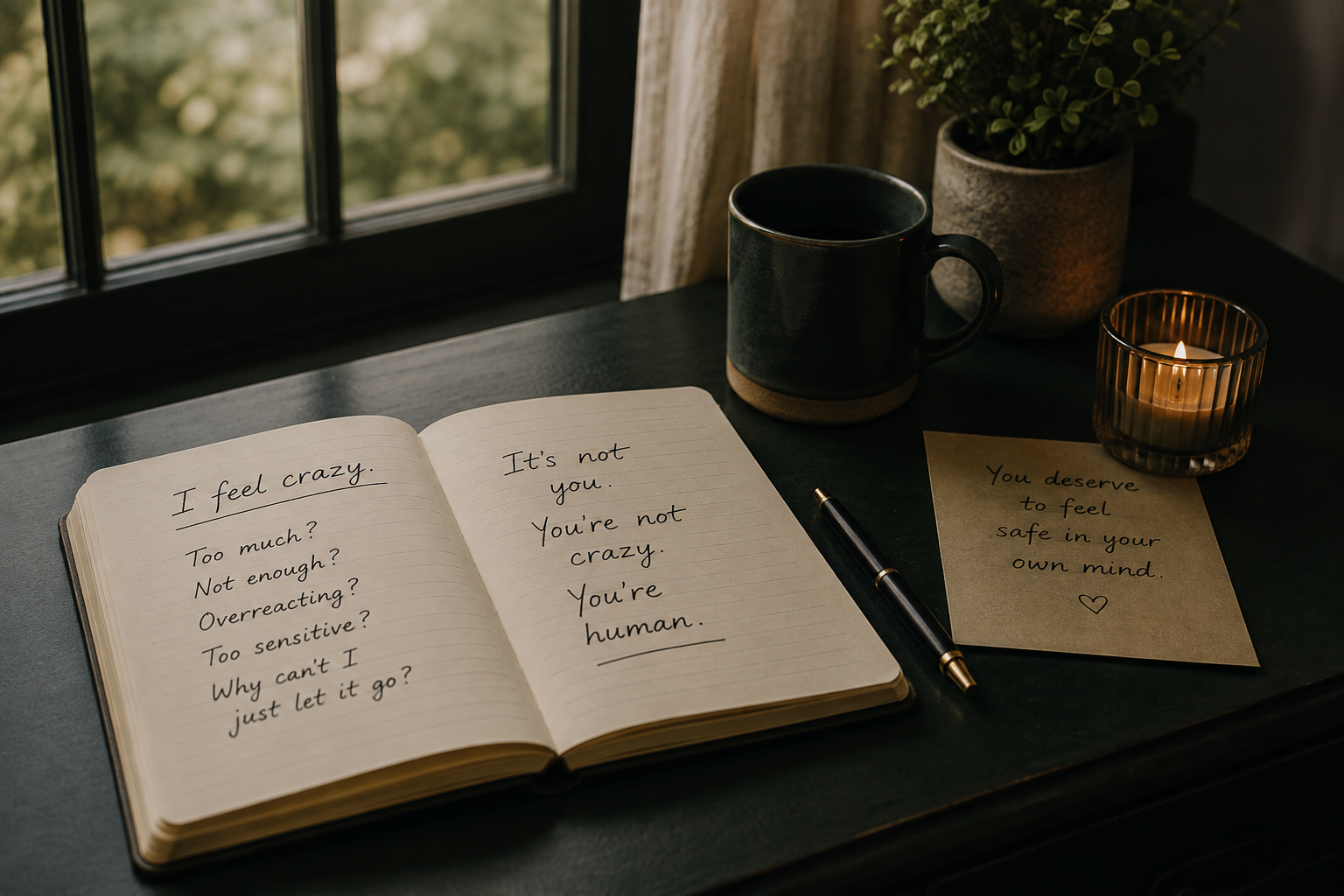
Why Do I Feel Crazy After Arguments?
A quieter way to understand the fog and self-doubt that can follow a difficult exchange.
Read the guide →
Best Questions After Emotional Manipulation
Questions that help you return to your own experience when a conversation has left you unsettled.
Read the guide →
The Emotional Abuse Cycle
How harm, relief, and renewed hope can make a repeating pattern hard to see.
Read the guide →Atmospheric photography from the Quinn Morgan article collection.