The Recovery Room
Why Do I Feel Guilty After Setting Boundaries?
Feeling guilty after setting a boundary does not always mean you did something wrong. Here is what that guilt may be telling you.

You may finally say something simple: “I cannot talk about this right now.” “I need to leave by eight.” “Please do not read my messages.” Then guilt arrives before the other person has even answered. Your chest tightens. You start building a case for why you deserve the limit. You wonder whether you are being cold, unreasonable, difficult, or selfish.
That feeling can be especially confusing when the boundary is small. You are not trying to hurt anyone. You may only be asking for rest, privacy, time with a friend, space to think, or a conversation without yelling. Yet the guilt can feel so sharp that withdrawing the boundary seems easier than sitting with it.
Feeling guilty after setting a boundary does not automatically mean you did something wrong. Sometimes it means you are doing something unfamiliar in a relationship where your needs have had very little room. This guide can help you look at the feeling with curiosity, not use it as a verdict against yourself.
Guilt is a feeling, not always a signal that you caused harm
Guilt can be useful when it points toward something you want to repair. Perhaps you broke a promise, spoke cruelly, ignored a need you had agreed to meet, or crossed someone else’s boundary. In those moments, guilt can invite accountability.
But guilt can also appear when you have simply disappointed someone, changed an old pattern, or stopped doing more than your share. Those are not the same thing. A person can be unhappy with your answer, and you can still have made a reasonable choice.
The difference matters because many people have been taught to treat another person’s discomfort as proof that they are at fault. If someone sighs, pouts, gets quiet, calls you selfish, or reminds you of everything they have done for you, you may feel pressured to fix their feelings before you have had time to notice your own. The guilt may be saying, “This feels dangerous because it is new,” rather than, “You have done something cruel.”
Try asking: What did I actually do? Did I insult, threaten, deceive, or deliberately harm this person? Or did I say no, ask for a change, protect my time, or stop accepting something that hurts me? Keeping those questions separate can make the next moment clearer.
Why a reasonable boundary can still feel so hard
Boundaries often feel difficult because they interrupt a role you may have been carrying for a long time. Maybe you have been the person who smooths things over, anticipates moods, answers immediately, absorbs the criticism, or apologizes before anyone has decided you did anything wrong. That role may have helped you get through a stressful home, family, friendship, workplace, or relationship. It may also have taught your nervous system that peace depends on you being easy to manage.
When you set a boundary, you step out of that familiar job. You stop providing the answer, reassurance, access, attention, or emotional labor someone has come to expect. Even if the boundary is healthy, the change can bring an old fear: What if they are angry? What if they leave? What if I am blamed? What if I have to explain myself until I give in?
That fear is not a character flaw. It is information about what has felt necessary before. The article Constantly Apologizing explores how saying sorry can become a way to reduce tension quickly, even when the blame was never yours to carry.

Discomfort is not the same as danger
Some boundaries create ordinary discomfort. A caring person may wish you had more time, feel disappointed by a changed plan, or need a little time to adjust. They may even disagree with your decision. What matters is whether they can stay in contact with your humanity while they have feelings about it.
Respect can sound like: “I am disappointed, but I understand.” “I need a minute to take that in.” “Can we find another time?” The person does not have to love the boundary to respect it. They do not have to agree that your need is important in order to stop treating it as a personal attack.
A more concerning response is one that makes you pay for the boundary. The person may threaten to leave, mock you, call you names, give you the silent treatment, show up uninvited, demand access to your devices, recruit other people to shame you, or keep escalating until you take the limit back. That is not simply an uncomfortable conversation. It may be part of a pattern of control.
The National Domestic Violence Hotline describes emotional abuse as behavior used to control, isolate, frighten, or undermine another person. If setting a boundary brings fear of retaliation, your safety matters more than saying the perfect sentence or proving that the boundary is fair.
A boundary is about what you will do, not how to control someone else
It can help to remember what a boundary is and what it is not. A boundary is not a demand that another person feel differently. It is not a way to make them understand, admit fault, or become more caring. It is a statement about your own limits and what you will do to protect them.
For example, “You have to stop yelling” may be a reasonable request, but it still depends on the other person choosing to change. “If yelling starts, I am going to end the conversation and leave the room” names what you can do. “You need to answer every text” tries to control access. “I will not keep texting after I have said I need space” describes your limit.
That distinction can remove some of the guilt. You are not trying to run someone else’s life. You are deciding what access, treatment, and conversations you can participate in. The person may not like that decision. They still have choices of their own. Your boundary does not take away their agency.
- “I cannot lend money right now.”
- “I am not discussing this while we are both upset.”
- “I will leave if I am called names.”
- “I need my phone and accounts to stay private.”
- “I am not available this weekend.”
Short sentences can feel almost too simple when you are used to explaining every reason. Still, you are allowed to be clear without turning your need into a debate.
Notice when guilt pulls you back into an old pattern
After you state a limit, you may hear an inner voice telling you to take it back quickly: “Just apologize.” “It is not worth the fight.” “Maybe I did misunderstand.” “I can handle one more thing.” Sometimes that voice is trying to protect you from a reaction it has learned to expect.
Pause before acting on it. You do not have to decide that the boundary is permanent. You do not have to become perfectly confident overnight. You only need enough room to ask what is happening. Did the guilt appear because you acted against your values, or because someone else became uncomfortable when you stopped abandoning yourself?
It may help to write down the sequence in plain language: what you asked for, how the other person responded, what you felt pressured to do next, and what happened when you gave in or held steady. The point is not to make a case against anyone. It is to give yourself a record that does not disappear the moment someone has a strong reaction.
If criticism regularly turns your need into evidence that you are selfish, Am I Overreacting to Criticism? can help you look at the difference between feedback that leaves room for you and a pattern that slowly takes that room away.

You do not have to explain a boundary until it becomes permission
Overexplaining often starts with a good intention. You want to be kind. You want the person to understand. You want to show that you are not trying to hurt them. The trouble is that a person who does not respect your no may treat every reason as an opening to negotiate.
You say you need rest, and they argue that they need you more. You say you cannot afford it, and they tell you that you always find money for other things. You say you need privacy, and they insist that only dishonest people want privacy. Before long, the conversation is no longer about your limit. It is about whether your reason is good enough to survive their cross-examination.
When it is safe, try a brief answer, then repeat it without adding new evidence. “I hear that you are upset. I am still not available.” “I am not comfortable with that.” “I have already answered.” This is not a trick for making someone calm down. It is a way to stop giving away more of yourself in an argument that has stopped being respectful.
Sometimes the safest boundary is not said aloud at all. If someone monitors your phone, money, movements, friendships, or access to support, a direct confrontation can create more risk. The Digital Abuse in Relationships guide explains why privacy can matter so much in controlling situations. You are allowed to choose a quiet, private step instead of an announcement.
When another person’s reaction tells you something important
A boundary can reveal the shape of a relationship. A person who cares about you may not always respond perfectly, but they can usually return to the conversation, hear that you have a limit, and take responsibility when they cross it. They do not need you to become smaller so they can feel okay.
When someone responds with punishment, fear, surveillance, threats, or a cycle of warmth only after you surrender the boundary, that response deserves attention. The issue is no longer whether you said the words in exactly the right tone. The issue is whether you are being allowed to have limits at all.
The guide Is the Silent Treatment Abuse? may help if withdrawal becomes the price of raising a concern. A pause can be healthy. Punitive silence can teach you to stop speaking long before anyone says you are not allowed to.
If you are afraid of what might happen when you say no, make safety the first priority. The National Domestic Violence Hotline offers confidential support options in the United States when it is safe to reach out. You do not need to confront anyone or have a full plan before you deserve support.

A quieter way to practice believing yourself
You may not feel brave when you set a boundary. You may feel shaky, guilty, sad, or tempted to undo it. That does not mean it was wrong. A new limit can feel uncomfortable because it asks you to stay close to yourself in a moment when you once had to leave yourself behind.
Start smaller than your guilt says you are allowed to. Take time before replying. Let a call go to voicemail. Say you will think about it. Make one plan without explaining it away. Notice how your body feels after a conversation where you did not immediately rush in to repair another person’s feelings.
When you want a private place to sort through those moments, My Clarity Journal offers guided pages for separating what happened from the doubt that follows. The free Clarity Files can be a smaller place to begin. You do not have to decide everything today. You can begin by letting your need exist long enough for you to hear it.
Frequently asked questions
You are allowed to have needs without a courtroom case.
Why do boundaries make me feel guilty?
Guilt can show up when you have learned that other people's comfort is your responsibility, especially if saying no once brought criticism, anger, withdrawal, or a long explanation of why you were selfish. The feeling is real, but it is not automatic proof that your boundary was wrong.
Is it selfish to set boundaries in a relationship?
No. A boundary is a clear statement about what you can do, what you need, or what you will step away from. It can be kind and still be firm. Healthy relationships make room for two people's needs, rather than asking one person to give up theirs to keep the peace.
What if someone gets angry when I set a boundary?
Someone may feel disappointed, but disappointment is not the same as permission to punish, threaten, shame, monitor, or frighten you. If a boundary brings fear of retaliation, take that seriously. You do not need to force a conversation or announce a plan when privacy and safety matter more.
How can I set a boundary without overexplaining?
Try one short sentence that names your limit and stops there. For example: “I cannot discuss this tonight,” “I am leaving if I am yelled at,” or “That does not work for me.” You are allowed to pause before adding more reasons. A boundary can be clear without becoming a case you have to win.
Keep reading
More language for holding onto yourself.

Walking on Eggshells in a Relationship: What It Can Mean
When you are constantly monitoring moods, the pattern deserves a closer look.
Read the guide →
Emotional Neglect: Signs You May Be Missing
A gentle way to notice when your feelings and needs have had too little room.
Read the guide →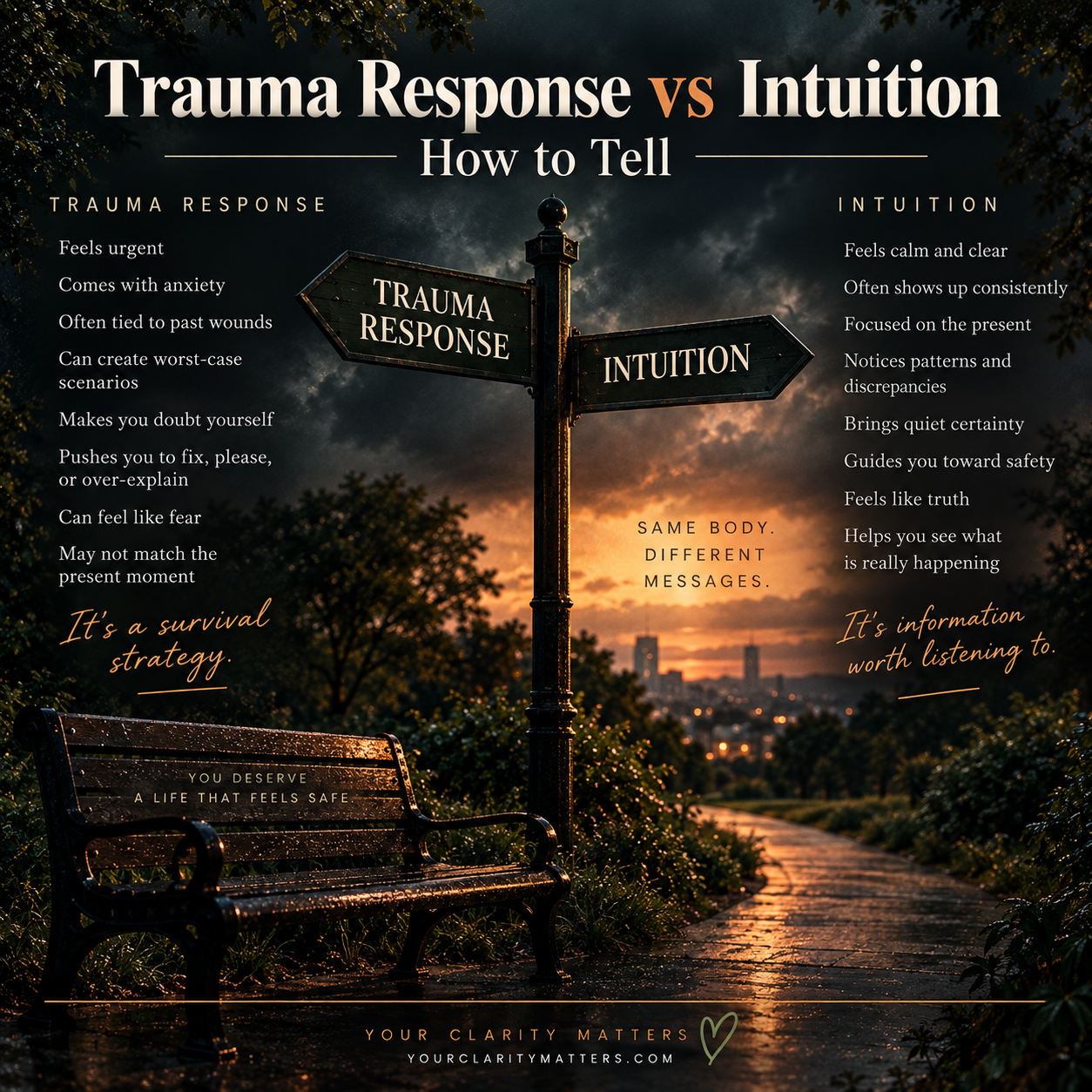
Trauma Response vs. Intuition: How to Tell the Difference
A clearer way to understand what your body may be telling you after difficult experiences.
Read the guide →Atmospheric photography from Unsplash.