The Recovery Room
Trauma Response vs. Intuition: How to Tell
A gentle guide to understanding trauma response vs. intuition, noticing patterns, and giving yourself time before deciding what a feeling means.
Your phone lights up with his name, and your stomach drops before you have even read the message. Or he says, “We need to talk,” in a perfectly ordinary voice, and suddenly you are explaining yourself, apologizing, scanning his face for danger.
Then comes the question that can keep you awake for hours: Is this a trauma response vs. intuition? Am I picking up on something real, or am I reacting because I have been hurt before?
If you have spent a long time being told that your reactions are unreasonable, that you misunderstood, or that you are making too much of things, this question makes sense. You may have learned to distrust the very part of you that notices when something feels off.
You do not have to solve it instantly. Clarity is often less about finding one perfect answer and more about slowing down enough to see what your body, your history, and the present moment are each trying to tell you.
Why trauma response vs. intuition feels so confusing
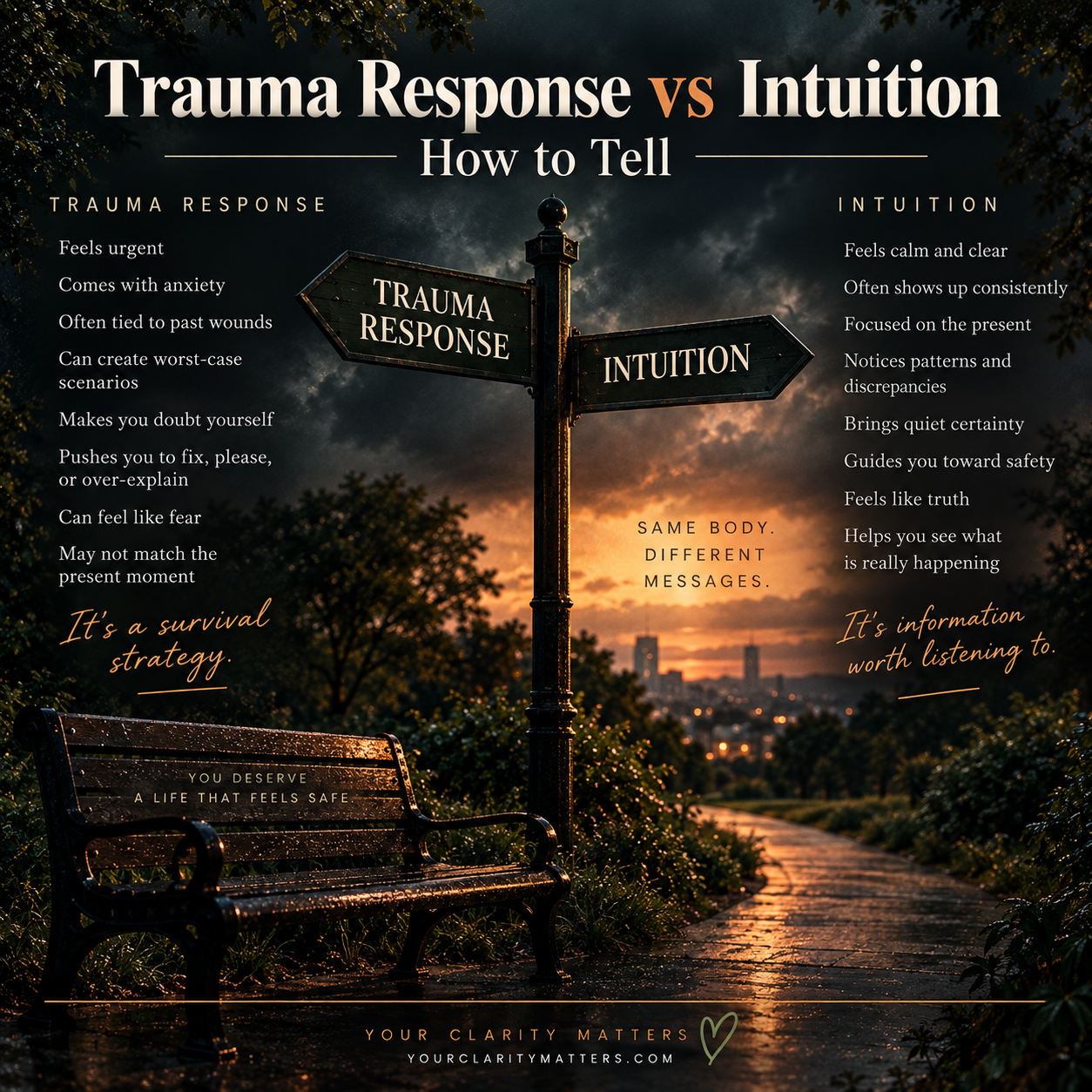
A trauma response is your nervous system trying to protect you. It may show up as panic, freezing, fawning, shutting down, overexplaining, checking your phone repeatedly, or feeling an urgent need to fix the tension. These reactions are not proof that you are irrational. They are often evidence that your body learned what it had to do to get through difficult moments.
Intuition can also begin in the body. It may be a tightness in your chest, a quiet reluctance, a sense that someone’s words do not match their behavior. That overlap is what makes this so hard. Both can arrive before you have a neat explanation.
The difference is not that intuition is always calm and trauma is always intense. Intuition can be urgent when there is real risk. Trauma can feel quiet, especially when you have learned to go numb or become very agreeable to stay safe.
What matters is the pattern around the feeling. Does it come with a specific present-day signal? Does it ease when you gather more information? Does it pull you toward a grounded next step, or into a familiar cycle of fear, self-blame, and trying to manage someone else’s mood?
You are not failing because you cannot always tell immediately. When someone has repeatedly denied your reality, confusion is often part of the injury.
A trauma response often feels like the past arriving all at once
A trauma response can make a current moment feel much bigger than it appears from the outside. A delayed text may bring back every time you were ignored to punish you. A slightly colder tone may make you brace for the argument that used to follow. Your body may react before your thinking mind catches up.
That does not mean the current situation is harmless. It means your system is responding to more than one thing at a time: what is happening now and what happened before.
One clue is speed. Trauma responses often create a powerful sense of urgency: Reply now. Explain better. Do not upset him. Figure out what you did wrong. Make this feeling stop.
Another clue is collapse into certainty about yourself. You may quickly land on, “I am too much,” “I should not have said that,” or “I am probably imagining it.” Notice how these thoughts turn your attention away from his behavior and toward your supposed defects.
When you are activated, you do not need to argue yourself out of your feelings. Start smaller. Put both feet on the floor. Take a sip of water. Step into another room if you can. Say quietly: “Something in me feels unsafe right now. I can wait before I decide what it means.”
Waiting is not denial. It is a way of giving yourself room to see more clearly.
Intuition usually points toward a pattern, not just a feeling
Intuition is not magic, and it is not a command you have to obey without question. It is information. Sometimes it is your mind and body noticing details you have not yet put into words.
Maybe he apologizes after each cruel comment but repeats the same behavior. Maybe he is charming in public and punishing in private. Maybe every disagreement somehow ends with you comforting him, apologizing, or questioning your memory. You may not have a single dramatic incident to point to. But you may have a growing awareness that the pattern leaves you smaller, less certain, and more alone.
Intuition often becomes clearer when you write down facts. Not conclusions. Not a case you have to prove. Just what happened.
You might record the date, what was said, what you said, what happened next, and how you felt after the conversation. Then return to it later, when your body is calmer. Ask yourself whether this was an isolated moment, or whether you have seen this sequence before.
This can be especially helpful when someone changes the story afterward. A private record gives you something steady to come back to when you begin wondering whether you remembered it wrong.
Questions to ask when you are unsure
You do not need to interrogate yourself. The goal is gentle observation, not cross-examination. If you are wondering whether you are responding to the past, the present, or both, try these questions:
- What happened right before I felt this shift in my body?
- What are the observable facts, without explaining them away?
- Does this feeling connect to a repeated behavior or a familiar cycle?
- What story am I telling myself about my responsibility for his reaction?
- If I did not have to make a decision tonight, what would I want to notice next?
That last question can be a relief. You may be accustomed to feeling that every uncomfortable moment requires a verdict: stay or leave, confront or forgive, trust or do not trust. But there is another option. You can observe.
You can say, “I am not sure what this means yet, but I am going to take myself seriously.”
When both are true
Sometimes your trauma response and your intuition are both speaking at once.
For example, you may feel panicked because a conversation reminds you of past moments when he blamed you for everything. The panic may be connected to old pain. And the conversation may also contain real present-day blame, deflection, or pressure. You do not have to choose one explanation and discard the other.
This is where many women get stuck. They realize they have trauma and then use that fact against themselves. They tell themselves that because they are sensitive, they cannot trust any concern. But having a trauma history does not make you incapable of accurately noticing harm. It may mean you need more gentleness and more time as you sort through what you notice.
Try separating the layers on paper. Write, “What this reminds me of,” and then, “What is happening right now.” Keep both columns. The first deserves compassion. The second deserves attention.
How to make the next moment smaller
You do not need to settle the whole relationship in one difficult conversation. If you are safe enough to pause, choose one small action that returns you to the present: step outside, text a trusted person, shower, eat something, or wait until morning before replying. The purpose is not to suppress what you feel. It is to give your thinking self time to stand beside your alarm.
When you return to the moment, look for the facts that do not change with his mood. What did he say? What did he do? What did you ask for? What happened after you named it? You may still feel unsure. But uncertainty is different from automatically assuming you are wrong.
If the feeling keeps returning around the same behavior, take that repetition seriously. You do not need to turn it into a verdict. You can let it guide a boundary, a private note, a conversation with someone safe, or a decision to give yourself more space.
Return to the feeling when you have more room
You may not be able to understand a feeling while you are in the middle of an argument, a flood of texts, or a tense room. That is not a failure of intuition. It is what happens when your attention is busy getting through the moment. If it is safe, return to the question later, after you have slept, eaten, spoken to someone kind, or spent time away from the pressure.
Ask yourself what remains once the urgency has eased. Do the facts still concern you? Does the same behavior keep appearing? Do you feel more settled after giving yourself space, or do you notice that you have been talked out of something important? A feeling does not need to be perfectly explained before it deserves a closer look.
This practice can also make it easier to distinguish care from control. Someone who cares about you may welcome a pause, answer a reasonable question, or return to a difficult subject with respect. A controlling pattern often becomes more intense when you take time, ask for clarity, or stop reassuring the other person that everything is fine.
Clarity does not require confrontation
You may not be ready to name what is happening out loud. You may share a home, finances, children, a workplace, or a life that makes direct confrontation feel complicated or unsafe. You do not owe anyone a confrontation in order to validate your own experience.
Private clarity can be enough for today. You can keep notes somewhere secure, pay attention to how you feel before and after contact, and give yourself permission to pause before responding. If you believe you may be in immediate danger, reaching out to local emergency services or a domestic violence hotline can help you think through safer options.
For the quieter, confusing moments, let the question be less “Can I prove this?” and more “What is this pattern asking me to notice?” That shift can bring you back to yourself.
Let your body have a voice, not the final verdict
Your body has been paying attention, even when you had to minimize, endure, or keep the peace. It may be sounding an alarm because something is wrong now. It may be sounding an alarm because something was wrong before. Often, it is asking for care either way.
You do not need perfect intuition to deserve gentleness. You do not need a flawless explanation to take notes, create space, or stop pushing yourself to be comfortable with what hurts.
If all you can do today is write down one moment that did not sit right with you, that is enough. You are not overreacting by becoming curious. You are waking up to your own experience, one honest detail at a time.
Frequently asked questions
You do not have to abandon yourself to be fair.
Can trauma make it hard to trust my intuition?
Yes. When you have been hurt, dismissed, or repeatedly told your reactions are wrong, it can become difficult to separate an old alarm from a present-day signal. That does not mean you have lost the ability to notice what is happening. It may mean you need time, facts, and gentleness.
Is intuition always calm?
No. Intuition can feel urgent when there is real risk, and trauma can sometimes feel quiet or numb. Instead of judging the intensity of the feeling, look for the present-day details, patterns, and next step that helps you stay grounded.
What should I do when I feel triggered?
You do not have to decide what the feeling means in the moment. If it is safe, pause, orient yourself to where you are, and come back to the observable facts later. If you are afraid of someone’s reaction or in immediate danger, prioritize getting support and safety.
Can both trauma and intuition be true at once?
Yes. A moment can remind you of past harm and contain a real signal in the present. You do not have to discard one layer to take the other seriously. Both can give you useful information.
Keep reading
More language for trusting what you notice.

Why Do I Feel Crazy After Arguments?
When conflict leaves you foggy or ashamed, find language for what may be happening.
Read the guide →
Gaslighting Versus Genuine Forgetfulness
The difference between an honest mismatch in memory and a pattern that dismisses yours.
Read the guide →
Constantly Apologizing: Is It Emotional Abuse?
Notice how fear, blame, and overexplaining can become a familiar way to seek peace.
Read the guide →