The Recovery Room
DARVO Relationship Examples You Can Recognize
See how DARVO can show up after a broken promise, a hurtful comment, a boundary, or a question that deserves an answer.

You bring up something that hurt you. Maybe it was the text he sent, the promise he broke, or the way he spoke to you in front of other people. You expect the conversation to be about what happened. Instead, within minutes, you are apologizing, defending your tone, or wondering whether you were unfair to mention it at all.
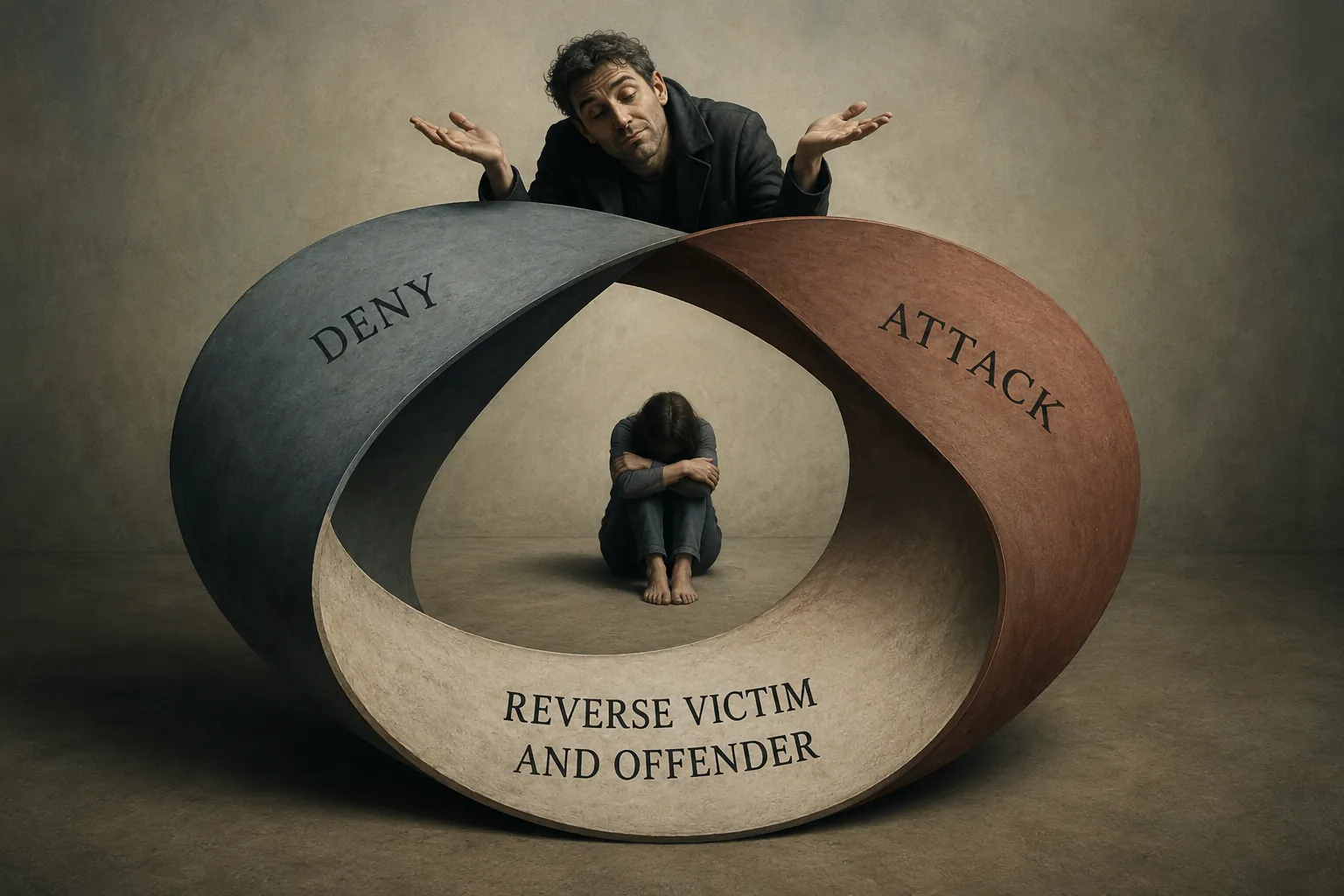
DARVO relationship examples can put language to that disorienting shift. DARVO is a pattern people may use when they are confronted about harmful behavior: deny what happened, attack the person raising the concern, and reverse the roles of victim and offender. You are not asking for too much by wanting to stay with the original issue. And you are not failing because the conversation keeps getting pulled somewhere else.
What DARVO can feel like inside a relationship
The letters describe a sequence: Deny, Attack, Reverse Victim and Offender. In real life, it may not sound scripted. It may arrive through anger, tears, cold silence, wounded disbelief, or a sudden list of everything you have supposedly done wrong.
The result is often the same. The person who caused harm becomes the person needing comfort. The person who raised the concern becomes framed as cruel, controlling, unstable, or impossible to please. The original behavior disappears beneath the conflict created around your reaction to it.
That is why DARVO can be so hard to spot while it is happening. You may be focused on calming him down, preventing another escalation, or proving that you did not mean to hurt him. By the end, the question you started with may feel distant and strangely embarrassing.
One hard conversation does not, by itself, tell you everything about a relationship. People can become defensive, embarrassed, or clumsy when they are confronted. The pattern matters. Notice whether there is room for the original concern after emotions settle. Does he return to it, take responsibility, and make repair? Or does every concern reliably become evidence that you are the problem?
DARVO relationship examples in everyday moments
You mention a broken promise
He said he would come home early for something important to you. He arrives hours late without letting you know. When you say you felt dismissed, he denies that he ever promised a time. Then he says you are always keeping score and making him feel like a failure.
Soon, you are explaining that you are not trying to criticize him. You may even apologize for bringing it up on a stressful day. But the unanswered question is still there: Why did he not communicate when plans changed?
You ask about a hurtful comment
At dinner, he makes a cutting joke at your expense. Later, privately, you tell him it stung. He says you are too sensitive and that everyone else thought it was funny. When you try to explain, he becomes angry that you are accusing him of being a bad person.
The denial may sound like, “That is not what I meant.” The attack may be, “You always twist things.” The reversal happens when you end up reassuring him that you do not think he is bad, while your hurt is treated as an inconvenience or a character flaw.
You notice secrecy around his phone
You ask a simple question because he quickly closes an app when you walk into the room. He immediately calls you controlling, jealous, or invasive. He may insist that your question proves you do not trust him, even if you never asked to see his phone.
Privacy is real, and every couple has different boundaries around devices. The issue is not that someone wants privacy. The issue is whether a reasonable question is met with openness and respect, or turned into an attack that makes you afraid to ask anything again.
You raise concern about money
You discover a purchase that affects a shared bill or account. When you ask about it, he denies it is a big deal, says you are bad with money anyway, and tells you that your questioning is causing him unbearable stress.
By the end of the conversation, you may be focused on proving that you are not greedy or controlling. Meanwhile, the purchase, the missing information, or the financial impact receives no real discussion.
You set a boundary after an argument
You say you do not want to continue a conversation while you are being yelled at, so you step into another room or ask to talk later. He responds that you are abandoning him, provoking him, or refusing to communicate. He may say that your boundary is the reason he became angry.
A boundary is not a punishment. It is information about what you will do to protect your own steadiness. Someone may dislike a boundary without being entitled to punish you for having one.
The clue is the shift in responsibility
DARVO often works because it asks you to abandon your own point of view. You begin with a clear experience: “That hurt,” “I was scared,” or “I need an answer.” Then the conversation becomes a trial of your motives, your memory, your tone, or your character.
Try noticing what happens just before you become confused. Was there a direct question that never received a direct answer? Did the subject change from an action to your personality? Were you required to comfort the person who hurt you before there was any acknowledgment of your pain?
You do not have to prove intent in order to take your own experience seriously. You may never know whether every reversal is calculated. What you can know is its impact: whether it leaves you smaller, quieter, ashamed for asking, and less able to trust what you saw.
A private way to reality-check the pattern
When a conversation leaves you spinning, it can help to write down only the basics before explanations take over. Keep it private and use whatever format feels safest for you.
Start with four lines:
- What happened before I raised the issue?
- What exact words or actions did I address?
- How did the conversation shift away from that issue?
- What did I feel pressured to apologize for or defend?
Then add one final question: Was my original concern ever answered?
This is not about building a legal case or forcing yourself into a decision before you are ready. It is a way to hold onto the beginning of the conversation, especially when the ending asks you to doubt it. Patterns are easier to see when they are not trapped inside one overwhelming moment.
You might also pay attention to repair. A person can say, “I got defensive. I do not like hearing that I hurt you, but I want to understand.” That does not erase harm, but it creates room for accountability. DARVO closes that room. It protects the person being confronted by making your pain the offense.
When naming it feels scary
You do not need to announce the word DARVO to the person using the pattern. Sometimes naming a dynamic out loud can lead to more denial, anger, or retaliation. Clarity does not have to be public to be real.
You can quietly remind yourself: “The subject changed.” “I was asking about one thing.” “I do not have to solve his feelings before I am allowed to have mine.” These small sentences can help you stay connected to yourself when the conversation is designed, intentionally or not, to pull you away from yourself.
If you fear that raising concerns could lead to physical harm, threats, monitoring, or punishment, your safety comes first. Consider what private support, a safer place to keep notes, or a trusted person might make you feel less alone. You are allowed to move at the pace your circumstances require.
The next time you replay an argument and wonder why you ended up apologizing for being hurt, return to the first moment. What did you notice? What did you ask? Your question deserved an answer. You are not asking for conflict by refusing to lose sight of it.
How Quinn's tools can help
When you need a quiet place to separate what happened from the guilt that followed, My Clarity Journal gives you guided space for facts, feelings, and patterns. You can also return to the broader guide, What Does DARVO Mean?, when you want a fuller explanation of the pattern.
Jennifer Freyd, who introduced the term, describes DARVO as a response to being held accountable. Her research overview offers the original context. You do not need research language, however, to honor what you experienced. You are allowed to notice when the question never gets answered.
Frequently asked questions
When the conversation leaves you holding the blame.
What is a simple DARVO example in a relationship?
You say that a joke at your expense hurt you. Your partner says the joke was harmless, calls you too sensitive, and then insists that you have made them feel terrible. The conversation moves from the joke and its impact to their hurt feelings about being confronted.
Is DARVO always intentional?
You may not know whether every reversal is planned. What matters is the pattern and its impact. If your concerns repeatedly get denied, turned into attacks on your character, and left unanswered, it is reasonable to take that experience seriously.
How is DARVO different from being defensive?
People can be defensive and still come back to a concern once emotions settle. A healthier response leaves room to hear the impact, acknowledge what happened, and repair it. DARVO is concerning when denial, attack, and role reversal reliably replace that accountability.
What can I do when an argument gets turned around on me?
If it is safe, pause rather than trying to prove every detail. Write down the original issue while it is fresh and consider speaking with someone who can listen without pressuring you. If you fear threats, monitoring, or physical harm, prioritize private support and safety planning.
Keep reading
More words for what you are carrying.
What Does DARVO Mean? A Clear Guide
The fuller picture of denial, attack, reversal, and what accountability can look like instead.
Read article →
Blame Shifting Examples That Can Leave You Doubting Yourself
Notice when a conversation moves away from an action and onto your supposed character flaw.
Read article →
Why You Feel Guilty Setting Boundaries
A boundary can be difficult for someone to hear without becoming something you did wrong.
Read article →