The Recovery Room
10 Blame Shifting Examples That Help You See Clearly
Ten blame shifting examples that can help you recognize when a concern becomes your fault, and return to what actually happened.

You bring up something that hurt you: the insult, the lie, the money that disappeared, the way he spoke to you in front of the children. Within minutes, you are apologising for your tone, defending your memory, or wondering whether you started the whole thing. Blame shifting examples matter because this reversal is often where confusion takes hold. The original harm gets buried under a new question: What did I do wrong?
Blame shifting is not the same as two people having a difficult conversation or both contributing to a disagreement. Healthy accountability can include context, feelings, and requests for change. But it does not erase the first person’s choices. Blame shifting moves responsibility away from the person who caused harm and places it onto the person who named it.
You do not have to decide what to call your relationship today to notice this pattern. You can simply begin paying attention to what happens when you bring up pain.
What blame shifting can sound like
The words can change from one home to another. What tends to stay the same is the outcome: he avoids accountability, and you leave the conversation carrying shame that was not yours to carry.
Here are 10 blame shifting examples that may help you put language to what has felt slippery or hard to explain.
1. “If you hadn’t made me angry, I wouldn’t have yelled.”
Anger is a feeling. Yelling, threatening, breaking things, or calling you names are choices. This statement makes you responsible for managing his behavior by becoming smaller, quieter, or more careful. Over time, you may start monitoring every word, believing you can prevent the next outburst if you just get it right.
2. “You know how sensitive I am about that. Why would you bring it up?”
Your concern disappears, and his discomfort becomes the emergency. He may be allowed to have feelings about a difficult topic. But sensitivity does not make him exempt from answering for hurtful behavior. Notice whether his pain is used to end the conversation every time you need an answer.
3. “I only lied because you would have overreacted.”
This reframes dishonesty as your fault. It asks you to focus on a reaction you have not even had yet instead of the choice to hide information. Sometimes people fear conflict. That can be discussed honestly. It still does not turn lying into something you caused.
4. “You pushed me to it.”
This phrase can follow verbal cruelty, intimidation, sexual pressure, reckless spending, cheating, or physical harm. It is a heavy sentence because it suggests you have power over actions that were never yours to choose. You may have disagreed, cried, asked questions, or tried to leave the room. None of those things transfer responsibility for what he did.
5. “You’re the one who ruined the evening.”
Maybe he made a cutting comment at dinner and you went quiet. Maybe you asked why he was drinking so much, and now everyone is tense. In this version, the issue is not the comment, the drinking, or the behavior that changed the room. The issue becomes your response to it. This can teach you to swallow hurt so other people stay comfortable.
6. “After everything I do for you, this is how you treat me?”
Kind gestures, financial support, work around the house, or gifts are pulled out as evidence that you have no right to raise a concern. Gratitude is not a contract that requires silence. Someone can do helpful things and still need to take responsibility for the ways they hurt you.
7. “You did the same thing last year.”
A past mistake may deserve its own conversation. But bringing it up in the exact moment you ask about his behavior can be a way to redirect the focus. The question becomes whether you are flawed enough to speak rather than what happened now. You can hold accountability for your own actions without allowing them to be used as a permanent shield against his.
8. “No one else has a problem with me. It’s always you.”
This can make you feel isolated and unreliable. But other people may not see what happens in private. They may see a charming, helpful, or restrained version of him. Even if someone else has a different experience, it does not cancel yours. Your pain does not need a group vote to be real.
9. “Look what you made me say.”
After a cruel remark, he may insist that your question, expression, or timing forced the words out of him. The sentence is designed to make the wound feel self-inflicted. A more accountable response would sound different: “I said something hurtful. I should not have said it.” If that kind of response never comes, the absence matters.
10. “Why are you trying to make me the bad guy?”
This can be especially disorienting if you were only asking for acknowledgment. The conversation shifts from the behaviour to his image of himself. You may rush to reassure him: “I’m not saying you’re bad.” Then the original issue vanishes. Naming harm is not the same as attacking someone’s entire character.
What accountability sounds like instead
Accountability does not require someone to agree with every detail of your experience. It does require them to stay with their own choices. A person can say, “I was angry, but I should not have yelled.” They can say, “I was worried about how you would respond, but lying was still my decision.” They can ask to talk about their own hurt without using it to erase yours.
You may hear context in an accountable conversation. You may hear that the other person felt embarrassed, overwhelmed, frightened, or misunderstood. Those feelings can be real. The difference is that context comes after the original harm is acknowledged, not in place of it. A real apology does not make you responsible for making the person who hurt you feel better before your own concern has even been heard.
It can help to listen for whether the response is specific. “I should not have called you that in front of the children” is different from “I’m sorry you feel that way.” Specific words show that the person understands what they did. They also make change easier to see later. When the language stays vague, or every apology quietly includes a reason you caused it, the responsibility may still be landing on you.
There is also room for your accountability. You can regret a sharp tone, a forgotten commitment, or something you said in anger. Taking responsibility for your part does not mean taking responsibility for theirs. Both things can be true at once: you wish you had handled one moment differently, and they still chose to insult, frighten, lie to, or control you.
The pattern is often in what happens next
One statement alone may not tell you everything. People can become defensive, say unfair things, and later reflect, repair, and change. What matters is the pattern over time.
After he shifts blame, does he return to the original issue without being forced? Does he offer a specific apology without adding “but you”? Does his behaviour change in a way you can actually feel, not just hear promised? Or do you end up comforting him, doubting yourself, and making a plan to avoid upsetting him again?
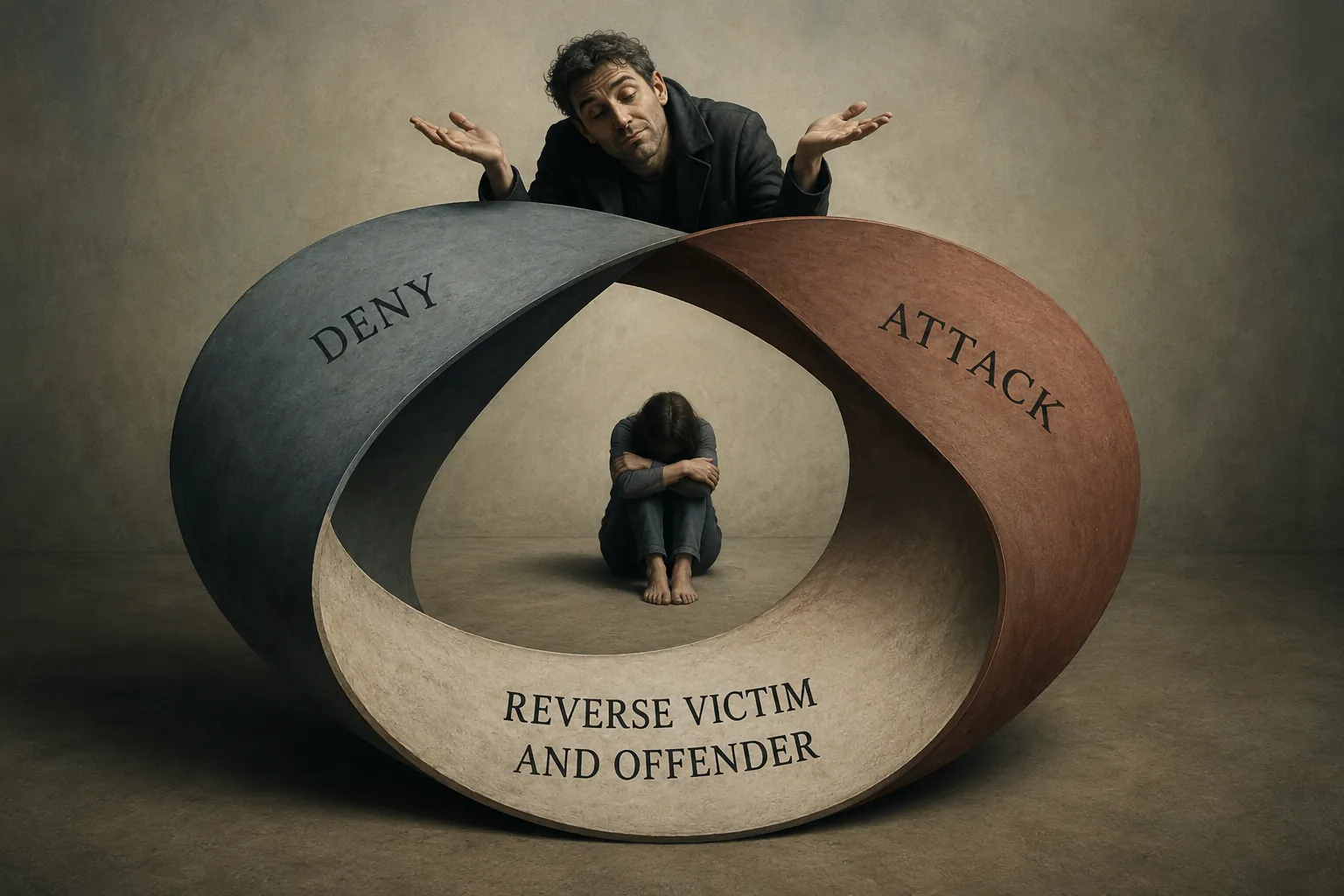
Blame shifting often works alongside denial and minimising, or turning the accusation back on you. You say, “You read my messages without permission.” He says, “If you weren’t hiding things, you wouldn’t care.” You say, “You scared me when you blocked the door.” He says, “You’re making a big deal out of nothing.” The details differ, but the effect is similar: your reality becomes harder to hold onto.
That confusion is not evidence that you are wrong. It may be evidence that you have been pulled away from the original facts too many times.
A private way to check your reality
You do not need to confront him with a list of patterns. In some relationships, confrontation can increase pressure, retaliation, monitoring, or escalation. Clarity does not require an announcement.
Instead, when something happens, write a few lines somewhere he cannot access if it is safe to do so. Keep it simple and factual. What happened? What did you say? What did he say in response? How did you feel before the conversation, and how did you feel afterward?
For example: “I asked why he cancelled my appointment without asking me. He said I was ungrateful because he pays for insurance. I apologised and never got an answer about the appointment. I felt confused and guilty afterward.”
You are not building a courtroom case. You are giving yourself a place where the sequence does not get rewritten. If keeping notes could put you at risk, do not keep them. You might instead notice the pattern mentally, speak with a trusted person when it is safe, or use a private moment to repeat the facts to yourself.
A useful question is: If I had not brought up the harm, would this conversation have become about my flaws? If the answer is often yes, that is information. Another question is: Did I leave with more clarity, or more responsibility for his behaviour?
You are allowed to return to the original question
Blame shifting is powerful because it creates urgency. Suddenly, you are defending your tone, your memory, your intentions, your past, or your right to be hurt. You may not be able to stop the conversation from being redirected. But internally, you can come back to the point.
“He insulted me.” “He hid this from me.” “He scared me.” “I asked a reasonable question.” These are not complete explanations for the relationship, and they do not force you into a decision before you are ready. They are simply the facts you are allowed to keep.
When you notice yourself rushing to defend every detail, you might pause and ask what question you were trying to answer before the conversation changed. You do not have to say that question out loud. You can write it down if it is safe, return to it later, or let it be the one thing you do not argue away inside yourself. A redirected conversation may still leave you unsettled, but it does not have to decide what you know.
If you have spent years explaining his behavior to yourself, start smaller. Let one clear moment remain clear. You do not need his agreement to notice what happened. You are not failing because you feel confused. You may be waking up to a pattern that taught you not to trust your own eyes.
You are allowed to take time before deciding what, if anything, you want to do next, even quietly.
Frequently asked questions
You are allowed to keep the facts in view.
What is blame shifting in a relationship?
Blame shifting is when someone moves responsibility for their own hurtful choice onto the person who named it. The original concern disappears and you are left defending your tone, intentions, memory, or character.
Is blame shifting the same as gaslighting?
They can overlap, but they are not the same thing. Blame shifting redirects responsibility. Gaslighting is a repeated pattern that can make you doubt what you saw, heard, felt, or remembered.
How can I respond when someone shifts blame?
You may not be able to make the other person take responsibility. If it feels safe, return privately to the simple fact: what happened, what you asked, and what response you received. You do not have to keep explaining yourself for your concern to matter.
What if keeping notes is not safe?
Do not keep notes if they could put you at risk. You might notice the sequence mentally, speak with a trusted person when it is safe, or repeat the facts to yourself in a private moment. Your safety matters more than documenting a pattern.
Keep reading
More language for returning to yourself.
What Does DARVO Mean? A Clear Guide
When your concern turns into their hurt, find language for the reversal.
Read the guide →
Constantly Apologizing: Is It Emotional Abuse?
Notice how repeated blame can teach you to carry more than your share.
Read the guide →
Why Does He Deny Everything? What It May Mean
A gentle guide to returning to the facts when a conversation leaves you doubting yourself.
Read the guide →