Guided entry pages
Begin with what happened, what you felt, what you needed, and what stayed with you afterward. The prompts help when finding the first sentence is the hardest part.
My Clarity Journal
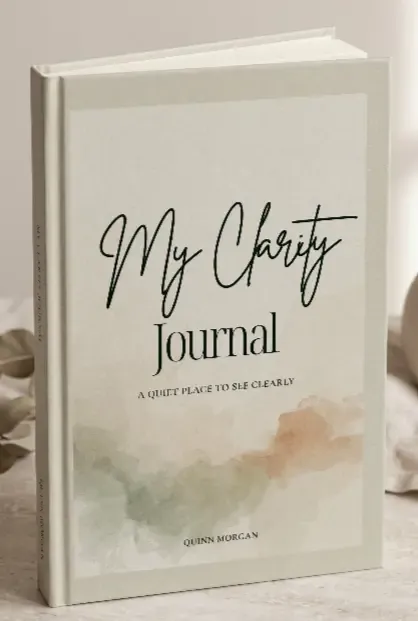
When your thoughts keep circling a conversation, a relationship, or a feeling you have learned to set aside, a guided journal can make a little room to listen. My Clarity Journal offers 220 private pages for the details, patterns, needs, and questions that deserve to be heard in your own time.
220 guided pages for reflection without pressure to have an answer.
When a blank page feels too big
Self-reflection is not about finding the perfect explanation for everything that has happened. Sometimes it starts with a smaller truth: that a moment is still sitting with you, that you keep changing the subject in your own mind, or that you would like to understand why a familiar situation leaves you feeling so far from yourself.
My Clarity Journal gives those moments a place to land. Its guided pages invite you to put the facts, feelings, and aftermath beside each other, without demanding that you make them neat. You can write about one conversation, a repeated dynamic, a need you keep minimizing, or a question you are not ready to say out loud. You decide what belongs on the page.
The journal is especially made for the times when another person's reaction has become louder than your own. Perhaps you find yourself replaying what you said, wondering whether you were too sensitive, or looking for a way to explain why something hurt. You do not need to settle the question before you give your experience room. A few honest lines can be enough to begin.
Inside the journal
Each part offers a clear place to begin while leaving the meaning of your experience in your hands.
Begin with what happened, what you felt, what you needed, and what stayed with you afterward. The prompts help when finding the first sentence is the hardest part.
Find clear language for patterns such as blame shifting, denial, love bombing, isolation, emotional manipulation, and gaslighting when the experience has been clearer than the words around it.
Look across the moments that repeat instead of asking one difficult day, one apology, or one doubt to explain the whole story.
Return to steady definitions when you need a calmer way to name something that has been minimized, denied, or made to feel confusing.
A private practice
Reflection at your pace
It can be tempting to treat reflection as a project with a finish line. You may think you should know why you feel this way, how to fix it, or whether you are making too much of it. But understanding often comes in smaller pieces. One page might hold the exact words from a conversation. Another might hold what changed in your body when you heard them. Weeks later, you may recognize a connection you could not see before.
That is why the journal makes room for both the event and its impact. You can record what happened without immediately deciding what it proves. You can name what you wanted without judging yourself for wanting it. You can come back to a question after you have had time away from it. Reflection does not have to become rumination when it is allowed to stay grounded in what you actually experienced.
Over time, the pages can help you notice the shape of your days. Maybe you feel calmer after spending time with certain people and smaller after speaking with others. Maybe you keep making room for a person who does not make room for you. Maybe you are more tired, more isolated, or less trusting of your own judgment than you used to be. The journal will not tell you what your life means. It can help you hear what you already know more clearly.
You can also use the pages to return to what is working. Notice the conversations where you felt heard, the places where your body softened, the people who left you feeling more like yourself, or the boundaries that gave you a little more room to breathe. Reflection is not only for the painful parts. It can help you recognize the conditions that support your steadiness, so you have something real to come back to when doubt gets loud.
If you are looking for a smaller place to start, the self-reflection journal prompts in the Recovery Room offer one question at a time. If you are trying to make sense of an emotionally confusing relationship, Quinn's emotional abuse recovery guide can offer wider language before you write.
Choose your edition
Both editions include the same 220-page guided journal. Spiral: $20. Hardcover: $24.50. Choose the format that feels most comfortable for the place and pace where you write.
A bound edition for returning to your notes whenever you need to.
Choose hardcover editionA lay-flat format for writing through one moment, one memory, or one pattern at a time.
Choose spiral editionSafety comes first
Writing can be useful only when it is safe enough to use. If someone monitors your phone, email, belongings, accounts, location, or private writing, consider whether a journal could create more risk. You do not owe any tool a complete record, and you do not need to write anything down to take your own experience seriously.
You can read a prompt without answering it. You can hold a detail in another way, wait until you have more privacy, or leave the journal for another time. The point is not to produce a perfect account. The point is to support your wellbeing in a way that does not make your situation harder.
For a single focused reflection instead of a longer journal, Quinn's guided worksheet bundle offers fifteen private pages. If you need confidential support or a quieter next step, visit the support page.
Frequently asked questions
No. My Clarity Journal includes guided entry pages, behavior checklists, pattern prompts, a plain-language glossary, and quiet wisdom pages between entries. It gives you a smaller way in when a blank page feels too open.
It is for anyone trying to stay close to their own experience after a relationship, conversation, or season of life has left them confused, diminished, or unsure what to make of what they feel. You do not need a label, a diagnosis, or a finished story to begin.
There is no required pace. You might use one page after a difficult conversation, return to it weekly, or leave it alone until a question needs room. The journal is there when it is useful, not as another task to complete.
Put safety first. If someone checks your belongings, devices, email, or private writing, choose the option that creates the least risk for you. This journal is a private tool, not emergency support.
Your clarity matters
Choose the edition that gives your thoughts a little more room to land.
Choose your edition